












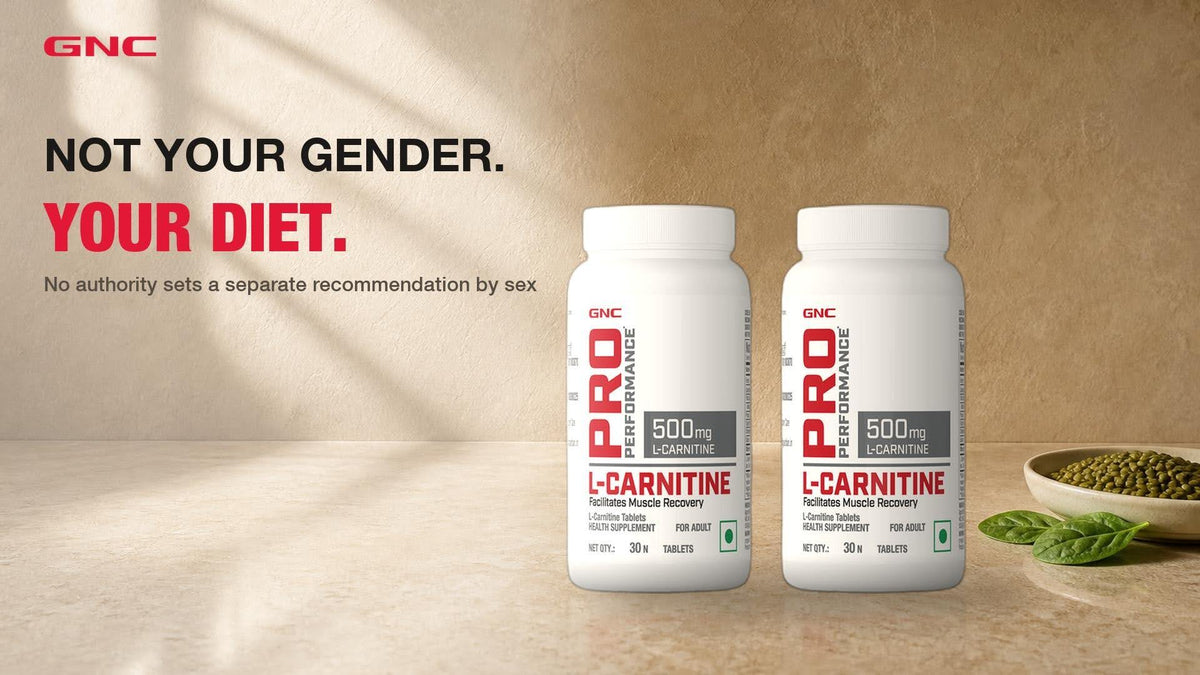
Quick Answer: There's no evidence that L-carnitine works differently in women than in men. No health authority sets a separate recommendation by sex. What actually shifts your carnitine status is your diet pattern, and even then the effect measured on body weight in trials stays small.
L-carnitine is marketed as a gender-specific product. You've one package for women and another package for men, but both packages have the same active ingredient.
Therefore, it's reasonable to ask if the research distinguishes between these two uses, or if the choice of packages is only a matter of marketing. This is what research shows, and what it doesn't show in relation to who should take L-carnitine and who might benefit from it.
Myth: L-carnitine works differently for women
False. There is no specific recommendation for carnitine intake for women by health authorities. NIH Office of Dietary Supplements indicates that approximately 15 mg of carnitine is needed by the body per day without specifying the requirements of men and women.
Therefore, this notion is incorrect. ODS mentions that in 1989, the Food and Nutrition Board investigated the potential of carnitine and found out that it is not an important element for health, and therefore nobody has any reference intake related to it. The body of healthy kids and adults does not need any carnitine from diet or food supplements.
Consequently, the marketing approach of carnitine products intended for women focuses on the promotional aspect, although it might not diminish their effectiveness. The point is to raise a different question that is even more relevant.
Where the gendered framing comes from
Carnitine performs the same functions for everyone as it transports long-chain fatty acids into your mitochondria where they are utilized in the energy production process.
The biology beneath is not affected by the gender of the person using it.
In cases where a label assures something purely based on your gender, scrutinize whether its claim originates from a scholarly article or merely from the packaging of the product.
Indian labelling sits under the FSSAI regulations, which govern what a health supplement pack may state rather than granting any product a gender-specific benefit.
Fact: your diet changes your carnitine status more than your gender does
Fact. Your everyday diet is the biggest driver of how much carnitine you take in. NIH ODS reports that for a person of about 75 kg, an omnivorous diet supplies 24 to 145 mg a day while a vegan diet supplies about 1.2 mg.
Set that against a daily need near 15 mg and the gap is obvious.
Your body is responsible for covering many of these gaps on its own. For example, ODS states that a strict vegetarian produces approximately 14.4 mg of carnitine per day, which is nearly enough to meet the body's daily requirement of 15 mg.
Absorption is also relevant. According to ODS, L-carnitine supplementation is absorbed in 14% to 18%, while 63% to 75% are figures for the carnitine found in food. You cannot compare a tablet with a plate of food.
What the 12-week vegetarian trial found
One study has to be examined in detail, as well as its limitations. 12 weeks addressed the fact that supplementation increased muscle carnitine levels by 13% in vegetarians but not at all in omnivorous subjects. The research involved 24 male subjects.
That single result explains the whole pattern.
Where a diet supplies very little, there's a real gap for a supplement to close.
Carnitine in, per day
| Where it comes from | Amount a day |
|---|---|
| What the body needs | about 15 mg |
| An omnivorous diet, person of about 75 kg | 24 to 145 mg |
| A vegan diet | about 1.2 mg |
| Made by the body, strict vegetarian | about 14.4 mg |
| Absorbed from a supplement | 14% to 18% of the dose |
| Absorbed from food | 63% to 75% |
All figures are NIH ODS.
Fact: the weight-loss effect measured in trials is small
Fact. The pooled evidence sits in a 2016 meta-analysis in Obesity Reviews by Pooyandjoo and colleagues, which combined nine randomised controlled trials covering 911 participants. Carnitine groups lost 1.33 kg more than control groups, with a 95% confidence interval of −2.09 to −0.57 kg.
Make sure to understand the next line of the assessment as well. The weight loss effect decreased significantly as time progressed at the level of p = 0.002. In simpler terms, we can say that the length of trials somehow reduced the impact of weight loss.
Regarding the standards of nutrition research, conducting nine trials is rather small. This also means that the number of participants per trial is limited since there are only 911 participants included in total.
Therefore it is appropriate to call 1.33 kg an authentic headline number, as it comes with a declining trend.
Who might reasonably consider it?
Two categories have the most straightforward advantage. Both those who abstain from food containing red meat and vegetarians consume much less of carnitine than anyone else.
In fact, they are the group in which the supplementation indeed shifted the muscle storage during the 12-week study described in ODS. We describe the tablets the same way in the product description: suited to vegetarians, to people who do not eat red meat, and to those on restricted diets.
This overlap arguably matters in India, where a significant proportion of consumers are vegetarians by default. If you happen to belong to this category, then our weight management range is worth reading solely because of the fit, rather than its expected results.
If you eat meat regularly, then your meals are likely contributing in part to the 24 to 145 mg band described in the ODS report.
What GNC's L-carnitine actually contains
GNC Pro Performance L-Carnitine Tablets 500mg deliver 500 mg per tablet is the first item in the ingredient list, while L-Carnitine L-Tartrate appears next. 60-tablet pack is mentioned in the list at ₹599, whereas ₹399 is the 30-tablet pack.
The provenance is mentioned on the package. The manufacturer of the tablets is Zeon Lifesciences Ltd from Paonta Sahib, Himachal Pradesh, in India according to FSSAI licence 10013062000225. Health supplements in India are sold using Labelling and Display Regulations, 2020 licence that must be your first check.
GNC also mentions Triple Strength L-Carnitine Liquid in 450 ml at ₹1,499, given tablets are not for your use. Whenever you select the form you want, scratch the label and input the code provided in product authentication page of GNC to check that your unit is real.
What should you keep in mind before starting?
Discipline is the primary principle to be applied here. According to NIH ODS, dosing around 3 g per day can result in nausea, vomiting, and abdominal pain among other negative effects because larger doses are not positive here. GNC's tablet has 500 mg, which is well below this dose.
While supplementation can help in maintaining a balanced diet, it is not a substitute for a healthy diet. If you are expecting or feeding a baby, suffer from a medical condition, or are on a regular prescription medication, consult your medical professional before using L-carnitine or any other supplement.
Frequently Asked Questions
Is L-carnitine safe for women?
NIH ODS mentions that there are no safety concerns related to gender in taking L-Carnitine and that there is no specific recommendation for women.
High dosages that approach 3 g per day can cause nausea, vomiting, and abdominal pain. The tablet of GNC gives 500 mg. If you are pregnant, nursing, or taking any form of medication, consult your doctor before using.
Does L-carnitine help with weight loss?
The combined data is limited. A 2016 meta-analysis of 911 subjects from nine clinical trials found that people who were treated with carnitine lost 1.33 kg more weight than those who received placebo, but the positive difference became smaller over longer studies.
Can vegetarians take L-carnitine?
Indeed, vegetarians have the strongest argument in this case. Vegan diets contain about 1.2 mg of carnitine per day, while the body needs around 15 mg. According to NIH ODS, a 12-week study showed that supplementation resulted in an increase in carnitine levels in vegetarians of nearly 13%, while omnivores experienced no increase.
Does L-carnitine affect hormones?
Nothing here answers that question. The NIH ODS material cited in this article covers carnitine intake, absorption and body weight, and settles nothing hormone-related questions. If you have a hormonal disorder, you should discuss the use of L-carnitine with your physician beforehand.
How much L-carnitine is in one GNC tablet?
Each GNC Pro Performance L-Carnitine tablet produces 500 mg, which has L-Carnitine L-Tartrate at the top of its ingredients list. Packages of 30 and 60 tablets are listed on guardian.in. Zeon Lifesciences produces it in Paonta Sahib, Himachal Pradesh under FSSAI licence 10013062000225.