











Quick Answer: EPA and DHA are the two long-chain omega-3s found in fish, and your body converts very little of them from plant oils. No daily amount has been set for either one. So read the EPA and DHA figure on the pack rather than the total fish oil figure, and take your softgel with a meal.
You picked up a fish oil pack, saw 1000 mg on the front, and still can't work out how much omega-3 that gives you. Fair. The two numbers that matter sit further down the label. Here's what EPA and DHA do, how much people commonly take, and what each pack in our omega-3 and fish oil range carries.
What do EPA and DHA actually do?
The long-chain omega-3 fatty acids, which include EPA and DHA, are derived from fish and seafood. The NIH Office of Dietary Supplements describes omega-3s as components of the membrane surrounding every cell in the body.
The fact sheet also cites high levels of DHA present in sperm cells, the retina, and the brain. Omega-3s also supply calories, and the sheet lists roles across the heart, lungs, immune system and endocrine system.
EPA and DHA aren't interchangeable with the omega-3 in flaxseed or mustard oil. That one is ALA. The liver converts only a little of it onward, and the NIH fact sheet puts reported conversion rates below 15%.
Why the source matters more here than with most nutrients
Fish do not produce omega-3s. Microalgae at the base of the marine food chain do that, and fish accumulate EPA and DHA by eating their way up the chain. So a fish oil softgel and an oily fish meal carry the same two fats.
Because conversion from ALA is limited, taking EPA and DHA straight from food or a supplement is the practical route.
How much do you need in a day?
No official daily amount exists for EPA or DHA. The NIH Office of Dietary Supplements states that recommended amounts haven't been established for omega-3s except ALA, and its adult figures for ALA are 1.6 g a day for men and 1.1 g a day for women.
Commonly used reference points still exist. That fact sheet reports the American Heart Association advising one to two servings of seafood a week, and about 1 g a day of EPA plus DHA for people who already have heart disease, preferably from oily fish.
What Indian dietary guidance adds to that
The ICMR-NIN dietary guidelines point out that fish and fish oils supply long-chain n-3 fatty acids that are biologically more active than the alpha-linolenic acid in plant foods. It also suggests a linoleic to alpha-linolenic acid ratio of 5-10 in the whole diet.
Fish is rare on many Indian plates, which is where a softgel comes in. Read any figure above as a commonly cited range rather than a prescription, and ask your doctor what suits you.
How much EPA and DHA does each of our fish oils give you?
The amounts of EPA and DHA vary in all of the four fish oils. Here's what the live product pages state.
| Our fish oil | Fish oil declared | EPA and DHA | Pack sizes |
|---|---|---|---|
| GNC Fish Oil | 1000 mg | 300 mg combined | 60, 90 and 180 Softgels |
| GNC Triple Strength Fish Oil | 1500 mg | 900 mg combined | 30 Softgels |
| GNC Triple Strength Fish Oil Mini | 750 mg per softgel | 450 mg total, as 270 mg EPA and 180 mg DHA | 60, 120 and 240 Softgels |
| GNC Salmon Fish Oil 1000mg | 1000 mg salmon oil blend, being 600 mg salmon oil and 400 mg fish oil | 180 mg EPA and 120 mg DHA per serving | 60 and 180 Capsules |
What the panel on the Mini spells out
GNC Triple Strength Fish Oil Mini publishes a full nutrition panel on a serving size of one soft gel capsule. Alongside the omega-3 rows it declares 13.5 kcal and 1.5 g of total fat.
Why the omega-3 line matters more than the oil figure
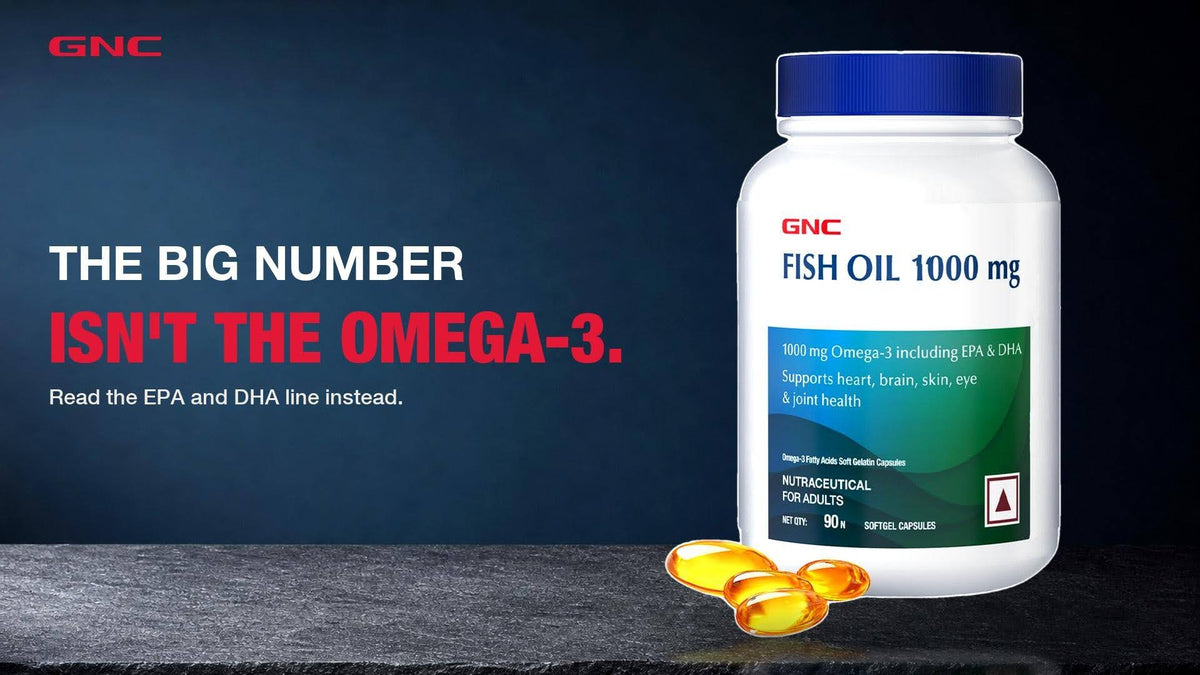
The big number on the front of a fish oil pack is total oil, and the omega-3 inside it is a smaller number. Our own labels print both, which is exactly how a label is meant to work.
So when comparing two packs, put the EPA and DHA line beside the EPA and DHA line. That's the comparison that says what's actually going in each day.
Which one suits which routine?
Match the pack to how you live rather than ranking them, because all four carry the same two fats. What changes is the concentration per softgel, the size of the softgel, and how long a pack lasts.
| Your routine | The pack that fits | Why it fits |
|---|---|---|
| An everyday habit you restock at your own pace | GNC Fish Oil | 1 to 2 softgels daily with a meal, in 60, 90 and 180 Softgels |
| One softgel a day and nothing more to remember | GNC Triple Strength Fish Oil | Concentrated and enteric coated, sold as 30 Softgels |
| Big capsules are a chore to swallow | GNC Triple Strength Fish Oil Mini | A mini soft gel taken once daily with food, in 60, 120 and 240 Softgels |
| Salmon oil is specifically what you want | GNC Salmon Fish Oil 1000mg | A salmon and fish oil blend in capsule form, in 60 and 180 Capsules |
Who each pack tends to suit
GNC Fish Oil sold in its usual presentation comes in three different sizes. GNC Triple Strength Fish Oil is the concentrated single-softgel option.
GNC Triple Strength Fish Oil Mini suits anyone who dislikes large capsules. Take it at roughly the same time each day. GNC Salmon Fish Oil 1000mg is there when salmon oil is what you're after.
How do you confirm your pack is genuine?
Scratch the code panel on the pack and enter that code on our product verification page. Every GNC pack sold in India carries its own code, and only we can authenticate one.
We've been a global specialty retailer of health and wellness products since 1935, operating over 9,000 locations across approximately 50 countries, and our stated global standard is truth in labeling, ingredient safety and product potency.
What the pack itself tells you
Turn the pack over and check three printed lines: the FSSAI licence number, the country of origin, and the allergen advice. All four of our fish oils are made in India, and all four contain fish.
Buy from us or from an authorised counter. Keep the pack sealed until you start it, and refrigerate our fish oil after opening.
Where supplements fit in your diet
A fish oil softgel supports a balanced diet rather than replacing one. Oily fish carries most of that load for people who eat it. For vegetarians, Indian dietary guidance points to mustard oil, legumes and greens.
Take your softgel with a meal, ideally after breakfast or lunch, and swallow it whole with water. Avoid taking it on an empty stomach.
When to speak to someone first
Talk to your doctor before starting if you're pregnant or nursing, if you take medication such as blood thinners, or if you have a medical condition. Anyone with a fish allergy should skip fish oil entirely, since all four of ours contain fish.
For the wider picture on this nutrient group, our guide to omega-3 fatty acids covers food sources and daily habits in more detail.
Frequently Asked Questions
How much EPA and DHA is in one GNC fish oil capsule?
Each of our four fish oils declares a different figure. GNC Fish Oil declares 1000 mg of fish oil with 300 mg of EPA and DHA. GNC Triple Strength Fish Oil declares 1500 mg with 900 mg. GNC Triple Strength Fish Oil Mini declares 750 mg per softgel, carrying 270 mg EPA and 180 mg DHA.
Is fish oil the same thing as omega-3?
Not quite. Fish oil is the oil, and EPA and DHA are the omega-3 fatty acids inside it. A pack declaring 1000 mg of fish oil isn't declaring 1000 mg of omega-3, which is why our labels print the EPA and DHA line separately.
Can you take fish oil every day?
Yes, daily use is the normal pattern, and our labels give the amount to take. Follow the directions on the pack you buy, take it with a meal, and check with a doctor first if you're on medication or managing a medical condition.
Do vegetarians get EPA and DHA from plant oils?
Only in small amounts. Plant oils supply ALA, and ICMR-NIN notes that the long-chain n-3 fats in fish are biologically more active than ALA. Conversion in the body is limited, so vegetarians relying on mustard oil, legumes and greens are mostly topping up ALA.
Does a bigger fish oil number mean more omega-3?
No. The front-of-pack figure is total oil, and the omega-3 share varies by product. GNC Triple Strength Fish Oil Mini declares 750 mg of fish oil with 450 mg of EPA and DHA, so read the omega-3 line on a pack before comparing it with another.