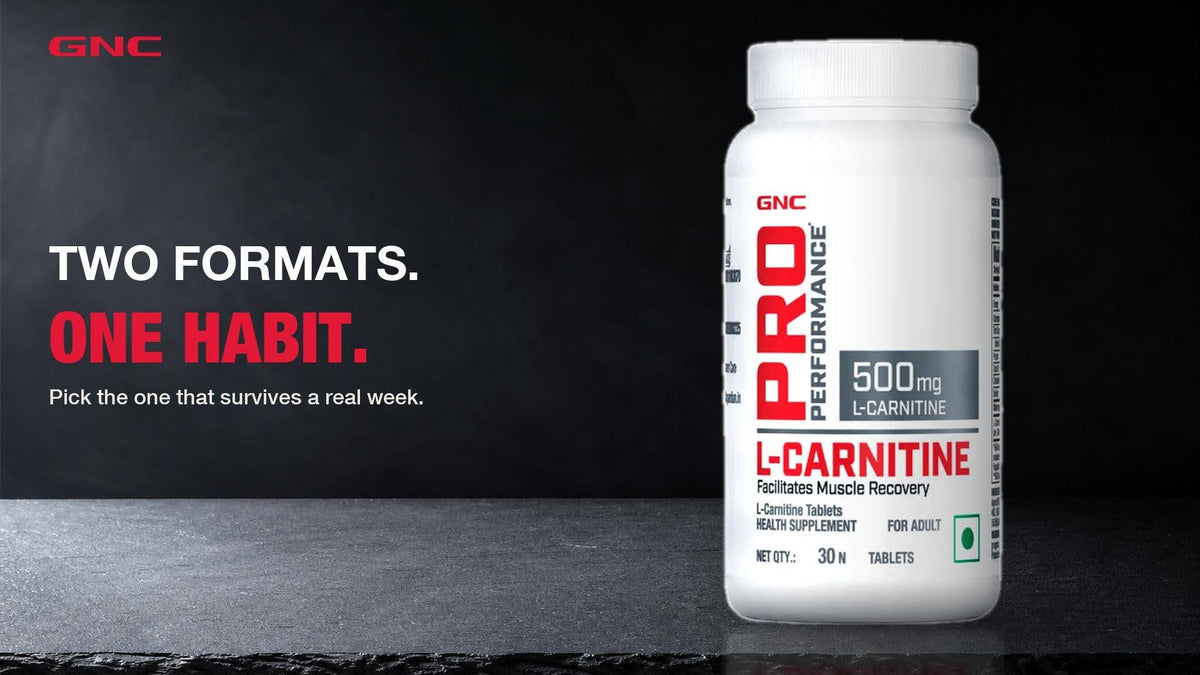












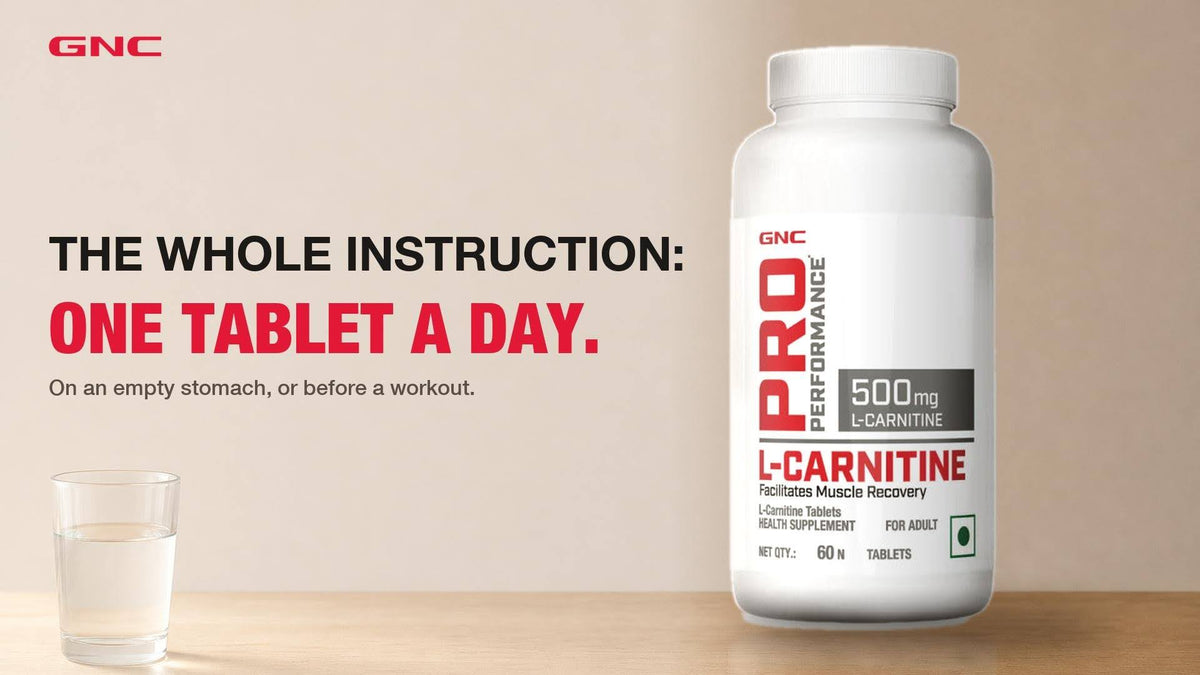
Quick Answer: Each GNC Pro Performance L-Carnitine tablet gives you 500 mg of L-Carnitine, and our label says one tablet daily with water, on an empty stomach or before a workout. The tablets come in three pack options. They're made for weight lifters, bodybuilders and serious athletes, and for people eating little red meat.
L-Carnitine is one of those supplements people pick up on a recommendation and then wonder how to actually use. If this is your first pack, you deserve a straight answer on what's inside it, how to take it, and what the research does and does not support.
Both of our L-Carnitine formats sit in the weight management range. This guide stays with the tablet.
What is in a 500mg L-Carnitine tablet?
Each tablet of GNC Pro Performance L-Carnitine Tablets 500mg delivers 500 mg of L-Carnitine. Our ingredient panel names it as L-Carnitine L-Tartrate, the salt form the active comes in.
The rest of that panel does a manufacturing job, not a nutritional one: diluents, disintegrating agents, coating agents, a binder, glidants and a stabiliser. No second active is added.
The tablets come in three pack options. The third one trips people up.
| Pack option | What the pack holds | Who it tends to suit |
|---|---|---|
| 30 Tablets | One pack of 30 tablets | Your first run at L-Carnitine |
| 60 Tablets | One pack of 60 tablets | A daily routine already in place |
| 60 Tablets (30 Tablets X 2) | Two separate 30-tablet packs together | One pack at home, one in your gym bag |
That last option is not a single 60-count pack. It is two 30-tablet packs sold together, so the second opens when the first runs out.
How do you take it, and when?
Take 1 tablet of GNC Pro Performance L-Carnitine Tablets 500mg with water. As a dietary supplement, take one tablet daily on an empty stomach, which is the timing our label leads with.
Our label names a second option as well. You can take the tablet before your workout instead, or follow whatever a healthcare practitioner suggests.
Nothing needs to be stacked with it, and the amount doesn't change on rest days. One tablet a day with water is the whole instruction, which is a large part of why people find tablets easy to keep up.
Both of those options come from our own label, so either one is a correct way to take the tablet. Pick the slot that fits your day, then repeat it. A single daily tablet makes that habit easy to hold.
Recovery is a common reason for reaching for L-Carnitine. Our guide to speeding up muscle recovery covers the sleep, training and food side of the same question, and it is worth reading alongside this one.
What should you expect in the first few weeks?
Expect less drama than this category usually promises. The evidence on supplemental L-carnitine is genuinely mixed, and you deserve that up front, not a claim we can't stand behind.
On exercise, the NIH Office of Dietary Supplements reports that carnitine supplements improved performance and shortened recovery time in some studies of trained athletes and active adults, but not in others. Further research is needed.
On body weight, the NIH consumer fact sheet on carnitine reports the same pattern. Some studies found people taking carnitine lost more weight than those who didn't, but the difference was small, only a few pounds. Larger studies are needed.
Absorption matters. The NIH Office of Dietary Supplements puts absorption of supplemental L-carnitine at about 14% to 18%, against the 63% to 75% bioavailability it gives for carnitine from food.
That gap shapes how to use the tablet, which is an addition to your diet, not a shortcut. If everyday eating is the bigger gap, speeding up your metabolism is the place to start.
Who is it for?
Our label is specific about this. GNC Pro Performance L-Carnitine Tablets 500mg is made for weight lifters, bodybuilders and serious athletes. We also position it for vegetarians, people who don't eat red meat, and anyone on a restricted diet.
That dietary point has real numbers behind it. NIH ODS puts a typical omnivorous diet at roughly 24 to 145 mg of carnitine a day for a person weighing 165 pounds, against about 1.2 mg on a vegan diet, because carnitine sits mostly in animal foods.
Being fair about the other side of it: the same NIH fact sheet says healthy children and adults make all the carnitine they need in the liver and kidneys, and no recommended daily amount has been set.
So this is a tablet you add for a training or dietary reason you can name, rather than one everybody needs. If neither reason applies, food is already doing the job.
How do you confirm your pack is genuine?
Every pack we sell carries its own scratch code. Scratch the panel, enter the code on our product verification page, and you get an answer in seconds. Each of those codes is issued by us, so our verification page is the one place that answer comes from.
The scratch panel itself is worth a look before anything else. An intact, unscratched panel means the code underneath has not been read by anyone else, which is exactly what should be true of a pack that has just arrived.
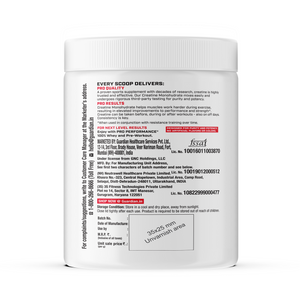
Two more marks sit on the pack itself. Our tablets carry FSSAI licence 10016011003870 for the marketer and 10013062000225 for the manufacturing site, and the country of origin is printed as India.
Those declarations are required under the Labelling and Display Regulations, 2020. If your pack is missing them, question it before it goes anywhere near your routine.
What to keep in mind before you start
Supplements support a balanced diet, they don't replace one, and no tablet substitutes for training, eating and sleeping well. Consult a physician first if you have a medical condition, if you are pregnant or nursing, or if you take regular medication.
Some interactions are worth raising with your doctor. The NIH consumer fact sheet notes that anticonvulsant medicines such as phenobarbital and valproic acid can reduce blood levels of carnitine, and that long-term use of certain antibiotics can lower carnitine in your body too.
On tolerance, the same NIH fact sheet reports that taking 3 grams or more a day of carnitine as a supplement can cause nausea, vomiting, stomach cramps, diarrhoea and a fishy body odour.
That fact sheet also flags muscle weakness in people with chronic kidney disease and a raised seizure risk in people who have a seizure disorder. One 500 mg tablet a day sits well below that figure, but your doctor's view still wins if any of those apply to you.
Frequently Asked Questions
Is one 500mg tablet a day enough?
One tablet daily is the amount our label directs, taken with water on an empty stomach or before a workout. NIH ODS has set no recommended daily intake for carnitine, because healthy adults synthesise what they need. Please check with your doctor before increasing the dose indicated on the label.
What does the 60 Tablets (30 Tablets X 2) pack actually contain?
The 60 Tablets (30 Tablets X 2) option holds two separate 30-tablet packs, not one 60-count pack. The tablet is identical across all three options at 500 mg of L-Carnitine each. Pick it to keep one pack at home and carry the other, or pick 60 Tablets for a single pack.
Do vegetarians need L-Carnitine tablets?
Carnitine sits mostly in animal foods, and NIH ODS puts a vegan diet at about 1.2 mg a day against roughly 24 to 145 mg on an omnivorous one. The same fact sheet says healthy adults still make what they need. We position the tablet for restricted diets, though that call belongs with a doctor.
Can you take L-Carnitine tablets on training and rest days?
Of course. Our label direction is one tablet daily and does not change with a training schedule. An empty stomach, or the stretch before a workout on training days, keeps it simple. Supplements support a balanced diet rather than replacing one, so the habit should sit alongside normal eating.
How do I check my GNC L-Carnitine pack is genuine?
Scratch the code panel on the pack and enter the code on our verification page. The FSSAI licence numbers and the country of origin should also be printed on the pack, both required by Indian labelling rules. A seller who cannot show an intact scratch panel is worth a second thought.