















Quick Answer: Yes, you can take magnesium and vitamin D3 together. The two are linked: the enzymes that turn vitamin D into its active form appear to need magnesium. In a 2018 trial of 180 adults, magnesium nudged vitamin D levels up in people who started lower and down in those who started higher.
You've just bought a strip of vitamin D3 because your last blood report came back on the low side. There's already a magnesium tablet on your bedside table. So can magnesium and vitamin D3 go down together, or will one cancel the other out?
They can go together.
The better question is why they keep turning up side by side. Vitamin D from sunlight, food or a capsule isn't ready to use when it enters your body. It has to pass through two chemical steps first, one in the liver and one in the kidneys, and the enzymes running those steps appear to lean on magnesium.
Does vitamin D need magnesium to become active?
Vitamin D appears to need magnesium to become usable, because the enzymes that process it seem to rely on magnesium as a cofactor. A cofactor is a helper mineral or molecule an enzyme needs before it can do its job. An enzyme is a protein that runs one chemical reaction in your body.
The chain, one step at a time
Step 1: vitamin D arrives, switched off. Sunlight on bare skin makes vitamin D3, and food or capsules supply D2 or D3. At this point it does nothing.
Step 2: the liver turns it into 25(OH)D. This storage form travels in the blood, and it is what the blood test for vitamin D measures.
Step 3: the kidneys turn 25(OH)D into the active form. The active form of vitamin D is the version that actually works, for example by helping your gut absorb calcium.
Step 4: other enzymes switch it off. When there is enough, they break vitamin D down into inactive forms.
Where does magnesium fit in the chain?
Magnesium appears to sit at every enzyme step, in both the liver and the kidneys. A 2018 review in the Journal of the American Osteopathic Association by Uwitonze and Razzaque pulled this research together, and its conclusion was that all the enzymes that process vitamin D seem to require magnesium.
Seem to. That is the honest wording.
A review sums up earlier studies rather than running a new experiment, so it tells you the link is plausible and well described, not that it plays out identically in every person.
The authors of the 2018 trial below add that, in lab and animal studies, the switch-off enzymes depend on magnesium too. So magnesium seems to keep vitamin D in balance rather than simply pushing it up. Our guide to vitamin D covers the basics.
What does low magnesium do to a vitamin D routine?
When magnesium runs low, the vitamin D you take may not be processed as smoothly, and a 2018 trial tested what adding magnesium does. The answer wasn't "more magnesium, more vitamin D". It was more interesting.
The 2018 trial that tested the link
The 2018 randomised trial in the American Journal of Clinical Nutrition by Dai and colleagues ran at Vanderbilt University Medical Center. It gave 180 adults aged 40 to 85 either magnesium or a placebo, a dummy pill, and neither the volunteers nor the researchers knew who got which.
The team then tracked 25(OH)D3, the main vitamin D3 reading on that blood test.
| Where a person's vitamin D started | What magnesium did to it |
|---|---|
| Close to 30 ng/mL (nanograms per millilitre) | Raised it |
| Higher, from about 30 to 50 ng/mL | Lowered it |
Magnesium didn't act like a booster.
It acted more like a balancer.
What "started lower" means in this trial
In this trial, "started lower" simply means a reading close to 30 ng/mL, against about 30 to 50 ng/mL for the volunteers whose levels fell. The authors concluded, carefully, that good magnesium status "may be important" for vitamin D status.
Can you take magnesium and vitamin D3 with the same meal?
You can take magnesium and vitamin D3 at the same time, with the same meal, and the studies in this article give no reason to space them apart. For how to take vitamin D itself, follow your pack.
Magnesium has no proven best hour in these studies, and nothing in them suggests the two block each other when they're swallowed with the same meal. The clock matters less than the habit.
So why not take both at once?
A routine that fits an ordinary Indian day
With dinner: magnesium and vitamin D3 together, with a meal you rarely skip.
Or split: vitamin D3 with lunch and magnesium closer to bedtime, if that's easier to remember.
Either way: the same time every day, because a habit you keep beats a perfect schedule you forget.
More isn't better with either one
Doubling up by habit is the easy mistake. On any label, check the magnesium per tablet, multiply by the tablets you take, and stay within the pack's directions.
For vitamin D3, follow the pack's dose, and ask a doctor before taking high-dose vitamin D. If you take regular medicines or have a medical condition such as kidney problems, consult your doctor before adding either supplement.
Why does vitamin K2 come up with vitamin D?
Vitamin K2 comes up because vitamin D increases proteins that only work once vitamin K has activated them, but the research says taking the two together might help, not that you need it. K2 is one form of vitamin K.
A 2017 narrative review in the International Journal of Endocrinology by van Ballegooijen and colleagues explained the link: vitamin D raises the production of vitamin K-dependent proteins, which stay inactive until vitamin K modifies them.
What the trials actually tested
Mostly bone health in women after menopause, and very little else.
The authors said joint vitamin D and K supplementation "might be" more effective than either alone, and they closed by pointing readers to a varied diet with vegetables and fermented dairy.
That is a long way from "you must add K2".
Searches often bundle vitamin D, magnesium and K2 as a set, but none of the studies here tested that trio. The magnesium link and the K2 link come from two separate lines of research that simply meet at vitamin D.
Which foods give you magnesium and vitamin D in an Indian day?
Magnesium is easy to find in Indian staples like whole moong, rajma, chana, ragi and nuts, while vitamin D comes mainly from sunlight, with some from foods.
The ICMR-NIN 2020 Recommended Dietary Allowances set magnesium at 440 mg a day for adult men and 370 mg for adult women. An RDA, or Recommended Dietary Allowance, is the daily amount that covers the needs of nearly all healthy people.
Which Indian foods are richest in magnesium?
Almonds lead at 318 mg per 100 g, ahead of whole moong and groundnut. The Indian Food Composition Tables (IFCT 2017), published by ICMR-NIN, give these figures per 100 g of raw food.
| Food (IFCT 2017, raw) | Magnesium per 100 g |
|---|---|
| Almonds | 318 mg |
| Whole green gram (moong) | 198 mg |
| Groundnut | 197 mg |
| Rajmah, red | 173 mg |
| Whole Bengal gram (chana) | 160 mg |
| Ragi | 146 mg |
| Whole wheat atta | 125 mg |
| Bajra | 124 mg |
| Brown rice | 93.91 mg |
| Spinach (palak) | 86.97 mg |
| White rice, milled | 19.30 mg |
Why does white rice sit at the bottom?
Milling strips most of the magnesium out of rice: 19.30 mg in raw white rice against 93.91 mg in brown rice. A bowl of dal, a whole-atta roti and a handful of groundnuts quietly add up.
Vitamin D: sunlight is a main source
As our vitamin D guide linked earlier explains, sunlight is a main source of vitamin D, while foods such as fatty fish, egg yolks, mushrooms and fortified foods add some.
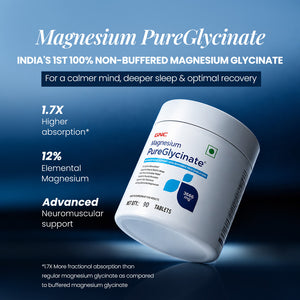
The form of magnesium in GNC Magnesium PureGlycinate
GNC Magnesium PureGlycinate uses magnesium glycinate, which is magnesium bound to glycine, an amino acid. Its product page describes it as "100% Non-buffered Magnesium Glycinate", written elsewhere on the page as non-buffered Magnesium Bisglycinate.
Non-buffered means the glycinate isn't mixed with other magnesium salts such as magnesium oxide. Our guide to how magnesium glycinate, citrate, oxide and other salts differ covers each salt.
The page's directions match what this article covered on timing: 1-3 tablets daily, either before bedtime or with your meal, so taking magnesium and vitamin D3 at dinner fits the page's directions.
Check your own pack for magnesium per tablet, add it to anything else you take that contains magnesium, and read the full directions on the Magnesium PureGlycinate product page.
The Bottom Line
Magnesium and vitamin D3 aren't rivals.
They behave more like two parts of one process.
Vitamin D has to be switched on in the liver and kidneys before it does anything, and the enzymes that turn vitamin D into its active form appear to need magnesium. The 2018 trial suggests magnesium steadies vitamin D rather than simply raising it.
That is a better reason to keep your magnesium intake steady than any promise of a quick boost.
In practice, that comes down to three habits. Build your plate around magnesium-rich staples like whole dals, millets and nuts. Take vitamin D3 and magnesium at a meal you won't skip. And think of K2 as an open question, not a requirement.
Frequently Asked Questions
Which should you take first, magnesium or vitamin D?
No study here shows the order matters, and swallowing magnesium and vitamin D3 with the same meal is fine. None of the studies in this article found that one gets in the way of the other. Pick the time you'll remember every day, and follow each pack's directions.
Does vitamin D use up magnesium?
Not proven. The enzymes that process vitamin D seem to require magnesium, which shows dependence rather than depletion. It has been suggested that very large vitamin D doses could draw magnesium down, but no trial here tested that. The practical point from Uwitonze and Razzaque's review: get enough magnesium if you take vitamin D.
Should magnesium be taken at night and vitamin D in the morning?
Splitting magnesium and vitamin D3 is not necessary, since no timing rule for magnesium has strong evidence behind it. A split routine is fine if it suits you: take each one at the same time every day, as its pack directs.
Do you need K2 as well?
Not necessarily, because the review behind the K2 advice says taking vitamins D and K together "might be" more effective, not that it's required. Most of those trials studied bone health in women after menopause.