











Quick Answer: Either form works if it delivers 3 to 5 g of creatine monohydrate a day, the amount studies used. A creatine gummy and a scoop of powder can carry the same creatine, but not the same amount per piece, so check the grams per gummy and count the pieces you need. Powder can give that amount in a single scoop.
You've probably seen them on your feed by now. Bright, chewy, fruit-flavoured creatine that looks nothing like the plain white scoop your gym friend stirs into water after every session.
So which one actually does the job?
Here's the thing. Creatine gummies and creatine powder are not two different supplements, because both can carry the same ingredient. What changes is how much of it sits in each piece, how many pieces you would have to eat in a day, and how much research stands behind each form.
You can settle it yourself, standing in a shop with a pouch in one hand.
This guide walks through it the way you would face it: one reader, one gummy label and one scoop, checked in three steps on the back of the pack. By the end, you'll know which label numbers matter and how to turn them into a daily count.
What's the difference between creatine gummies and powder?
A creatine gummy can hold exactly the same ingredient as a scoop of powder: creatine monohydrate. What differs is the number of grams each gummy carries, and that number decides whether a handful of gummies can match a single scoop.
Creatine monohydrate is simply creatine bound to one molecule of water. A 2017 position stand in the Journal of the International Society of Sports Nutrition (Kreider and colleagues) called it the most extensively studied and clinically effective form of creatine.
So a gummy is not a new kind of creatine.
A creatine gummy is the same old ingredient packed into a chewable sweet instead of a loose powder.
Whether a gummy works comes down to grams
The real question isn't "do gummies work?" It's "how many grams am I getting?"
Two numbers on the back label answer that: grams of creatine per serving, and how many gummies make up one serving. The front of a pouch does not have to show that division, so you do it yourself, with the grams on one side of the sum and the gummies on the other.
How many gummies does it take to match one scoop?
The count depends on the grams in each gummy. Divide the grams of creatine per serving by the number of gummies in that serving, and you have the dose per piece. Then count the pieces needed to reach the amount research used.
Picture a first-year lifter in a store aisle, pouch in hand. The front says "creatine". The back is where the answer sits.
Now the target.
Maintenance studies use 3 to 5 g a day, per Kreider and colleagues' 2017 position stand, and our guide on how much creatine you need in a month turns that into monthly grams.
Three checks on the back label
The three checks are grams per serving, gummies per serving, and gummies needed to reach the studied amount. The lifter runs them in order:
| Step | What to read on the back label | What it tells you |
|---|---|---|
| 1 | Grams of creatine per serving | How much creatine one serving really gives |
| 2 | Number of gummies in that serving | Divide step 1 by this to get grams per gummy |
| 3 | 3 g divided by grams per gummy, then 5 g divided by grams per gummy | How many gummies a day it takes to reach the amount studies used |
The lifter finishes the sums in the aisle. If step 3 means more gummies than they'd chew daily for weeks, the pouch goes back on the shelf. If it feels easy, the pouch goes in the basket.
Why powder is the form researchers studied, and the form that keeps
Monohydrate powder is the form most research has used since the early 1990s, according to a 2021 review in the same journal (Antonio and colleagues). Dry powder also keeps well.
A 2011 review in Amino Acids (Jaeger and colleagues) found monohydrate powder showed no breakdown after more than 3 years, even at 40°C.
Breakdown means creatine turning into creatinine, a leftover that no longer works as creatine.
In liquid, the review found creatine fairly stable at neutral pH (7; lower is more acidic). After 3 days at 25°C:
- 4% broke down at pH 5.5
- 12% at pH 4.5
- 21% at pH 3.5
A 2003 study in AAPS PharmSciTech (Ganguly and colleagues) saw 90% of a different creatine salt break down within 45 days in an acidic lab solution.
A gummy is neither dry powder nor a drink.
No study in this guide tested a creatine gummy.
How do gummies, powder and capsules compare?
All three formats can deliver creatine monohydrate. They differ in grams per piece, pieces per day and the research behind each.
| What to compare | Powder | Gummies | Capsules, pills, tablets |
|---|---|---|---|
| How you take it | Stirred into a drink | Chewed | Swallowed with water |
| Mixing needed | Yes | No | No |
| What you count each day | Scoops | Gummies | Capsules or tablets |
| Pieces or scoops per serving | One scoop | Several gummies, as the label lists | Several pieces, as the label lists |
Pills and tablets work like capsules: the daily total is grams per piece times pieces taken.
One scoop of powder can deliver the studied amount, if the label says so.
Is that a knock on creatine gummies? No. They can reach the same grams.
You just have to count higher.
Who a gummy suits, who a scoop suits
Creatine gummies suit you if you will not mix a drink every day and do not mind counting pieces. A scoop suits you if you want the studied amount in one serving and are happy stirring it into water.
A gummy might fit if you:
- travel a lot and cannot carry a shaker
- are happy to eat several pieces a day
A scoop might fit if you:
- want one serving that reaches the studied amount
- already have a post-workout drink to stir it into
Whichever form you pick, check that the label names creatine monohydrate and states grams per serving. Our guide on how to tell good-quality creatine from the rest covers what else is worth checking.
If you have a kidney or other medical condition, are pregnant or take regular medication, talk to your doctor before starting creatine.
Is the label maths different for women?
The maths does not change with who is eating it. Women and men read the same label, and the grams per piece do not change.
The powder GNC makes
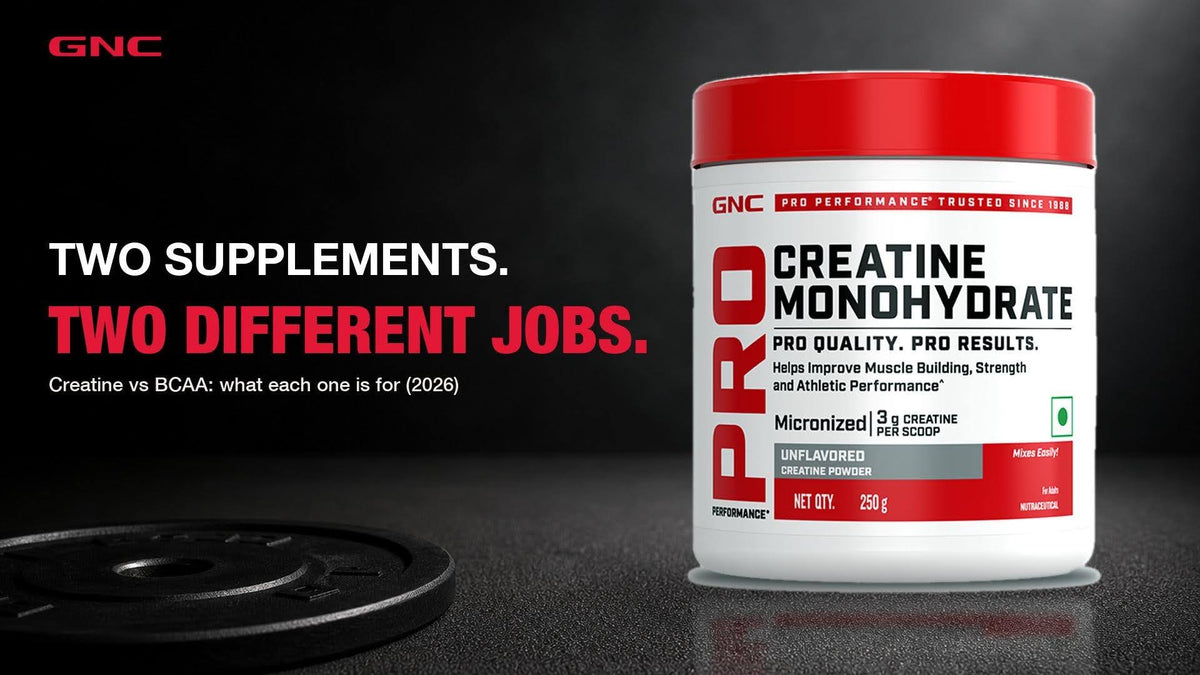
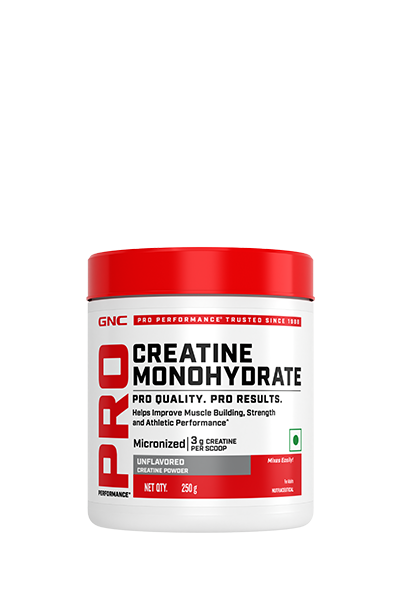
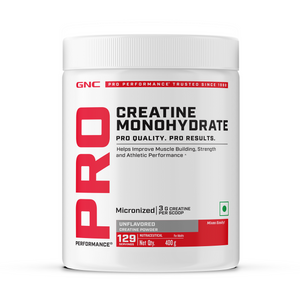
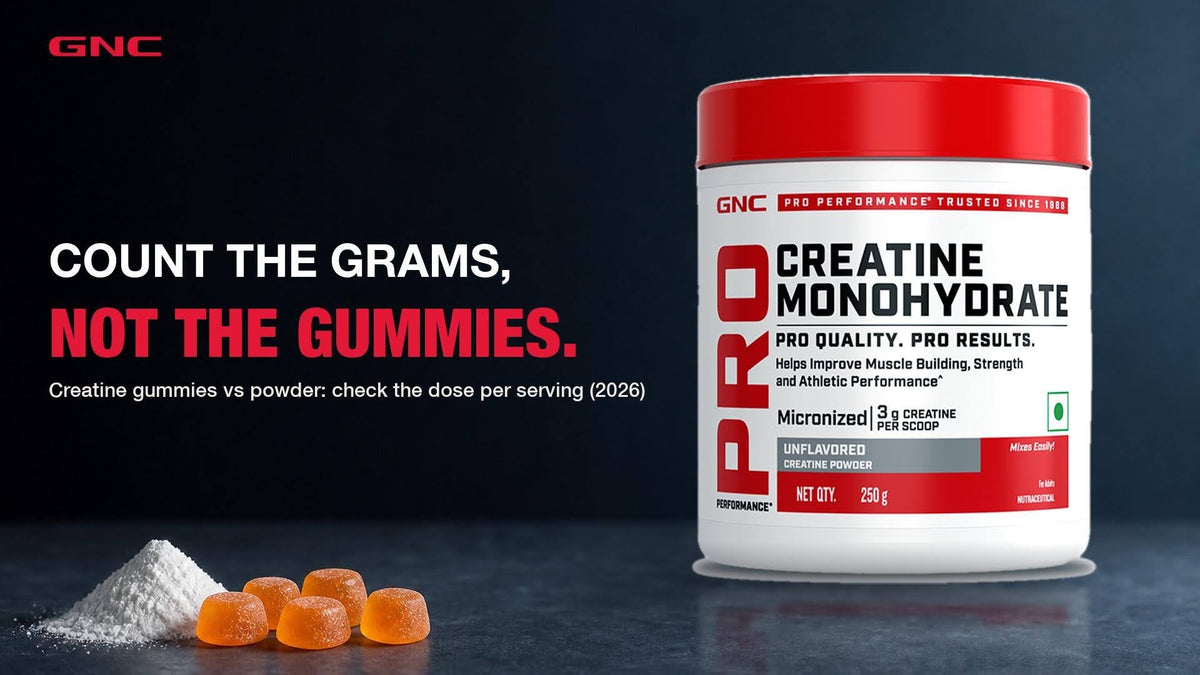
GNC Pro Performance Creatine Monohydrate is a powder, so it works the way this guide described: the whole serving goes into one drink rather than being spread across several pieces you have to count.
The product page says to mix one serving in 200-250 ml of water or your favourite sports drink, right after your workout, and to drink plenty of water while taking it.
It is also described as micronized and instantized. Micronized means the powder is milled into finer particles, and instantized is a label term for powder made to stir into liquid quickly. Both describe how it mixes, not what it does in your muscles.
It stays dry until you add water.
That's the form the storage research measured.
Mix the powder, then drink it.
Don't leave it standing in an acidic drink for days.
The full range sits in the creatine collection.
The Bottom Line
Creatine gummies versus powder is mostly an arithmetic question.
Both formats can hold the same creatine monohydrate. What changes is where the grams sit. A scoop can put the studied amount in one serving, while a gummy spreads it across several pieces.
So flip the pack over before you buy. Divide the grams by the gummies, then count up to the amount research used and ask whether that many chews fits your day.
Powder has the stronger record for now. Researchers have used it since the early 1990s, and dry powder barely changes in storage. No study in this guide tested gummies that way, so the label is the evidence on hand.
That is not a verdict against gummies. It's a reason to read their label more closely than a tub's.
Pick the form you will actually take every day. Then make sure the numbers add up.
Frequently Asked Questions
Do gummies work as well as a daily scoop?
If your gummies add up to the same 3-5 g of creatine monohydrate a day that the studies used, you are taking the amount the research describes. No study in this guide compared the two formats head to head, so the grams printed on the back label are the number to check before you buy a pouch.
Do gummies absorb differently?
No study cited in this guide compared how your body absorbs creatine from a gummy versus a powder, so this guide has no evidence either way. What is known is that creatine monohydrate powder is the form most creatine research has used, which is why its effects are the ones on record so far.
Do creatine gummies cause less bloating?
No study in this guide measured that, so any claim either way is a guess rather than a finding. None of the studies in this guide tested bloating with gummies, so a format is best chosen on its label and your daily routine, not on an untested promise on the pouch.
Are capsules a better middle ground?
Capsules skip both the mixing and the sweetness, but they share the gummy's arithmetic: grams per capsule multiplied by capsules per day. They make sense if you would rather swallow a few pieces with water than stir a drink, as long as the daily total still reaches the studied amount.