












Quick Answer: You choose an omega-3 capsule on the back label and at your own dinner table, with four checks. Read the EPA and DHA line, look for signs the oil is still fresh, and note the oil's source. Then match it to your diet: fish body oil if you rarely eat fish, algal oil if you never do.
You walk into a pharmacy, and every omega-3 pack on the shelf looks like the same person designed it. A leaping fish. A red heart. A big number ending in mg.
So how do you tell them apart?
Not from the front.
What decides whether a capsule is worth taking every day sits on the back label, inside the capsule itself, and on the dinner plate. Three of the checks are about the oil.
One is about you.
This guide works through all four in the order they matter, then matches a capsule to the way people actually eat, whether that's fish twice a week or dal and paneer every day.
Start with the omega-3 you actually get, not the oil
The first check is the EPA and DHA line on the back label, because that is the omega-3. The big number on the front is usually the whole oil.
The NIH Office of Dietary Supplements puts a typical 1,000 mg fish oil softgel at about 180 mg of EPA and 120 mg of DHA. That's roughly 300 mg of omega-3 inside 1,000 mg of oil, and two packs with the same front number can be far apart on the back.
We've unpacked that arithmetic, and what each of the two fats does, in what EPA and DHA do and how much you need. For choosing, one rule covers it.
Compare EPA and DHA with EPA and DHA. Never oil with oil.
Freshness is the check almost nobody makes
Omega-3 fats oxidise. They react with air, heat and light and slowly turn rancid, so a capsule's freshness matters as much as its milligrams.
The reason is in the molecule. EPA and DHA carry several double bonds, and each one is a spot where oxygen can attack.
How common is a stale capsule? A 2015 study in Scientific Reports by Albert and colleagues at the University of Auckland tested 32 fish oil supplements sold in New Zealand. 83% went over the recommended peroxide value, an early marker of oxidation, and only 8% stayed inside every oxidation limit the researchers checked.
The same study found just 3 of the 32 held at least the EPA and DHA their labels declared.
And the part worth remembering? The researchers found best-before date and country of origin were poor guides to quality.
That was one country's shelf, not India's. The chemistry travels.
What you can check at home
- Smell the pack on opening. Fish oil smells faintly of the sea. A sharp, paint-like or rancid smell is a different thing.
- Break one softgel when in doubt. Smell the oil itself, not just the shell.
- Look for an antioxidant in the ingredients. Vitamin E, often listed as mixed tocopherols, is added to many omega-3 oils to slow oxidation.
- Store the pack the way the label asks. Heat speeds oxidation, and a kitchen shelf beside the stove in an Indian May runs far warmer than any label assumes.
Fishy burps on their own don't prove a bad batch. The National Center for Complementary and Integrative Health lists unpleasant taste, bad breath and heartburn among the usual mild side effects of omega-3 supplements, fresh or not.
Where the oil came from changes what else is in it
The source printed on the label, whether fish body oil, fish liver oil or algae, tells you what comes along with the omega-3. Read it before the milligrams.
Tsutsumi and colleagues at Japan's National Institute of Health Sciences measured dioxins in 46 supplements made from fish, marine mammal or egg-yolk oils bought between 2007 and 2014, in a 2018 study in Chemosphere. Most products delivered under 5% of Japan's tolerable daily intake. The highest reading came from a shark liver oil product, at up to 70%.
Liver oils differ in a second way too. The NCCIH notes that fish liver oils such as cod liver oil also contain vitamins A and D, in amounts that vary by product, and both can be harmful in excess.
Body oil and liver oil are not the same purchase.
Mercury, and what a test report adds
What about mercury? It's less of a worry than most people assume. The NIH Office of Dietary Supplements notes that omega-3 supplements haven't been found to contain methyl mercury, because processing and purification remove it.
A brand that publishes batch test reports lets a buyer read purity results directly rather than take a front-panel promise on trust. If a pack mentions testing, look for where the report actually sits.
The vegetarian question most guides skip
For anyone who doesn't eat fish, an algal oil capsule supplies DHA directly, from the microalgae that fish get their omega-3 from in the first place.
That matters in India, where fish never reaches a lot of plates. The NCCIH is clear on the options: algal oils are a vegetarian source of DHA and some also contain EPA, while flaxseed oil contains ALA, a different omega-3.
What the algae trial found
For DHA, algae held its own against fish. In a 2008 study in the Journal of the American Dietetic Association by Arterburn and colleagues, 32 adults took 600 mg of DHA a day for two weeks, either from algal-oil capsules or from cooked salmon.
DHA in their blood rose by about 80% in plasma and about 25% in red blood cells. The two groups were equivalent.
The catch: the Arterburn trial measured DHA only.
For EPA from a vegetarian capsule too, check that the label declares both.
Pick a capsule you'll actually keep taking
The best capsule on paper does nothing in a drawer. Size, count and how it fits around meals are real selection criteria.
- Count the softgels in a day's serving. A concentrated oil means fewer of them. A standard one means more.
- Check the size if large capsules are a struggle. Mini softgels exist for exactly that reason.
- Take it after a meal. Omega-3 is a fat, and labels typically direct it after food rather than on an empty stomach.
- Check the shell on a vegetarian pick. Most softgels are gelatin, which is animal-derived. Plant-based capsules use a cellulose shell instead.
A capsule forgotten three days a week is the wrong capsule, however good its label looks.
Match the capsule to your plate
Diet decides which capsule makes sense more than any claim on the front of a pack.
Find the row that suits the way you eat
When the right row isn't obvious
Not sure which row fits? Count the fish meals in the last two weeks.
Two GNC omegas, read the way this guide reads them
Here's how the four checks apply to two capsules in the GNC omega and fish oil range, one for fish eaters and one for everyone else.
For fish eaters who prefer a small softgel
GNC Triple Strength Fish Oil Mini declares 450 mg of EPA and DHA in each 750 mg softgel. On the first check, that puts well over half of the oil down as omega-3.
The softgels are enteric coated and small, which suits anyone who finds a full-size fish oil softgel hard to swallow.
For vegetarians and vegans
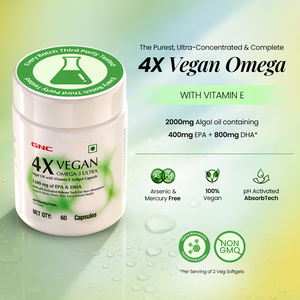
GNC Vegan Omega is sourced from microalgae and declares both EPA and DHA, so a vegetarian gets EPA as well as the DHA that algal oil always supplies. Its ingredients name mixed tocopherols as the antioxidant, its capsule shell is plant-based, and its product page links the latest batch test report.
Whichever capsule suits, it adds to a varied diet rather than standing in for one. Skip fish oil with a fish allergy, and if you're pregnant, nursing or on medication, especially blood thinners, talk to a doctor before starting.
The Bottom Line
Choosing an omega-3 capsule isn't about finding the biggest number. It comes down to four quieter questions.
How much EPA and DHA is actually inside? Is the oil still fresh? Where did it come from? Does it fit the way you eat?
Answer those, and the leaping fish on the front stops mattering.
The right capsule is the one taken every day, stored well, from a source that's clear on the label.
Frequently Asked Questions
Which omega-3 capsule should you buy in India?
The one that matches four checks. It declares its EPA and DHA clearly, shows care for freshness such as an added antioxidant, names its oil source, and fits the diet it's joining. That usually means fish body oil for someone who eats little fish, and algal oil for vegetarians and vegans.
Are vegetarian omega-3 capsules as good as fish oil?
For DHA, the evidence says they can be. A 2008 trial found algal-oil capsules and cooked salmon raised blood DHA by the same amount over two weeks. Algal oils always supply DHA and only some supply EPA, so check the label declares both if EPA matters to you.
How can you tell if fish oil has gone bad?
Smell it. Fresh fish oil smells mildly of the sea, while oxidised oil smells sharp or rancid. If the pack smells off, break a softgel and smell the oil inside, then check the best-before date. Keep the pack away from heat and direct sunlight.
Is cod liver oil the same as fish oil?
Not quite. Both carry EPA and DHA, but the NCCIH notes that fish liver oils such as cod liver oil also contain vitamins A and D in varying amounts, and both vitamins can be harmful in excess. Check the label if vitamin A or D is already part of the routine.
Should you take omega-3 capsules with food?
Yes. Omega-3 is a fat, and omega-3 labels typically direct the capsule after a meal rather than on an empty stomach. Follow the directions on the pack, and ask a doctor first if blood thinners are part of the routine.