












Quick Answer: Most people who struggle to gain weight are burning the surplus, not missing it. Appetite caps how much you eat, while your body quietly raises daily movement and heat output when you overeat. In overfeeding trials running 8 weeks or more, identical surpluses produced very different weight gains.
You eat what feels like a lot. Three full meals, snacks in between, a second helping whenever someone offers. The scale doesn't move.
Meanwhile a friend who eats less than you seems to gain weight just looking at a plate of rice. That's frustrating, and it usually gets blamed on a fast metabolism and left there.
The metabolism answer isn't wrong. It's just incomplete. Which is why so many people keep attacking this with more food and get nowhere.
Why some people struggle to gain weight
Some people struggle to gain weight because their bodies burn off a surplus rather than store it. Two forces drive it. One is an appetite that fills up early. The other is an energy spend that rises the moment more food goes in.
Your body spends more when you feed it more
Eating too much doesn't just raise the calories you take in. It raises the calories you burn. As a 1999 study in the journal Science by Levine, Eberhardt and Jensen showed, 16 non-obese adults over the course of an 8-week period ate an excess of 1,000 calories per day.
Among the 16 study subjects, fat storage differed 10-fold. Two-thirds of the extra energy they burned came from Non-Exercise Activity Thermogenesis (NEAT), which covers fidgeting, standing, posture and ordinary daily movement.
The volunteers who ramped up NEAT the most gained the least fat. Levine and colleagues reported a correlation of 0.77 between the change in NEAT and resistance to fat gain. None of it feels like exercise, so nobody notices.
Some of it is written into your genes
Genetics sets a large part of how your body handles a surplus. In a 1990 study in the New England Journal of Medicine, Bouchard and colleagues overfed 12 pairs of young adult male identical twins by an extra 1,000 calories a day, six days a week, for 100 days.
In that trial every man ate the same 84,000 extra calories. Mean weight gain was 8.1 kg, but the range ran from 4.3 kg to 13.3 kg. Twins within a pair responded alike, while different pairs responded very differently.
The phrase "I am not able to gain weight" describes a real physical difference, not a lack of effort. Two people genuinely start from different places.
Appetite is the second brake
Appetite is the real limit for most people. It isn't self-control or information. If you feel satisfied after consuming two rotis, then it is unlikely you will be able to follow the prescribed four-roti plan for more than a few days.
The clinical fix is more frequent meals, not larger ones. Mayo Clinic suggests five or six smaller meals a day rather than forcing bigger ones, alongside nutrient-dense snacks between them.
What a calorie surplus actually is, and how big it needs to be
A calorie surplus represents the excess calories an individual consumes in comparison to their calorie expenditure in a day. For most people it needs to be a few hundred calories held steadily, not a huge one held for a week.
The energy you expend fluctuates. It depends on the size of your physique, the training you do, and how much you do outside of fitness. The ICMR-NIN's Dietary Guidelines for Indians shows how far activity alone shifts the target.
The same body needs very different amounts depending on the work it does. A man on his feet all day can need over 1,100 kcal more than the ICMR-NIN sedentary reference figure, and that gap alone explains a lot of stalled weight gain.
How big the surplus needs to be
A few hundred calories above maintenance, held long enough to matter. Push the surplus higher and more of the gain arrives as fat, which is part of what the wide spread in the twin study reflects.
A moderate surplus held for six months is worth far more than an aggressive one dropped in a fortnight. The slower version is also easier to steer. There is time to see whether the gain is muscle or fat.
There's no honest way to predict how many kilograms you'll gain, or by when. The overfeeding research is exactly why. The same input produced very different outputs in people eating under supervision.
Why protein still matters when the goal is weight, not leanness
Protein decides how much of the weight you add is muscle rather than fat. It means that if you put on weight but don't eat enough protein, a larger share of that added mass will be fat.
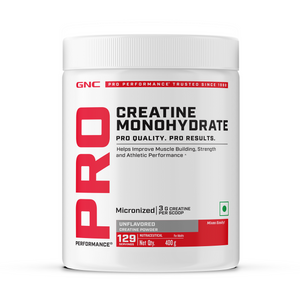
Morton and colleagues pooled 49 studies covering 1,863 healthy adults in the British Journal of Sports Medicine in 2018. Protein supplementation alongside resistance training significantly increased fat-free mass and one-repetition-maximum strength.
The same analysis found a ceiling. Beyond a total intake of roughly 1.6 g of protein per kg of body weight per day, adding more produced no further gain in fat-free mass from resistance training.
ICMR-NIN's reference allowance is 60 g for a 60 kg man and 55 g for a 55 kg woman. That's a health baseline, not a training target. Anyone lifting four times a week sits well above it.
Why resistance training decides whether the gain is muscle or fat
Resistance training workouts provide your body with instructions on where to put the surplus. Without it the weight still arrives, but you have far less say in what kind of weight it is.
That's the ground the protein evidence was built on. Morton's team only admitted trials where participants trained against resistance for at least six weeks, because the effect they measured depends on that stimulus.
There's no necessity for the programme to be complicated. Compound movements, a small increase in load or reps over time, three or four sessions a week, and real rest days between them should suffice.
There are also practical advantages. A consistent schedule for exercise provides a basis for eating. This makes eating on a schedule far easier than eating on willpower.
Where a weight gainer fits, and where food does the job better
Food does the job better whenever you can actually eat it. A weight gainer earns its place when you have problems with your appetite instead of food access.
Ghee rice, eggs, peanut butter, yoghurt and nuts all pack calories densely, and our rundown of high-calorie foods that support weight gain covers the shortlist worth building meals around.
That's the genuine argument for a gainer. A solid meal takes up more room in your stomach than the same calories drunk. So it's a tool for the exact problem this article describes: appetite running out before the day's calories do.
If formats and pack sizes are the question, our guide on how to choose a weight gainer that fits your routine walks through what to compare.
GNC Pro Performance Weight Gainer: what one serving is built to do
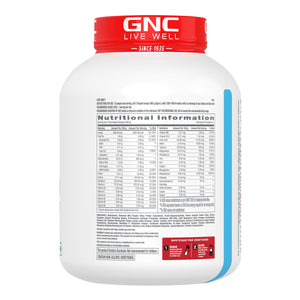
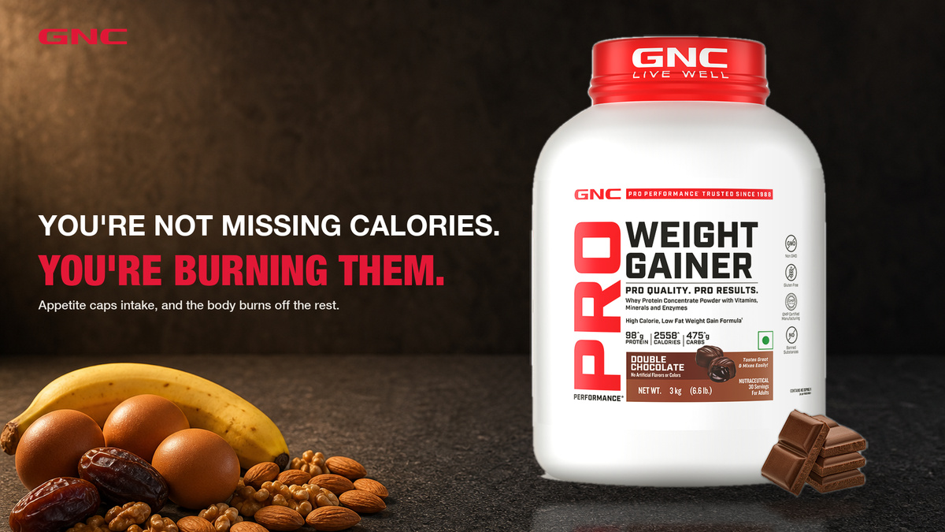
GNC Pro Performance Weight Gainer is a carbohydrate-and-protein powder built for that gap. Mix one scoop into 280-300 ml of water or milk. Shake it well before drinking.
The formulation features maltodextrin and protein sources like whey protein concentrate, sweet dairy whey, whey protein isolate and calcium caseinate. Other ingredients of the formula contain medium chain triglycerides, digestive enzymes and added vitamins and minerals, which is what keeps a high-calorie drink easy on the stomach.
No sugar, artificial colours or preservatives have been added. It is tested for banned substances by a world-class anti-doping lab. Pack size varies from 1 KG to 5 KG, available in Double Chocolate and Vanilla Ice Cream flavours.
Post-workout, between meals and before bed are the windows the label names. Directions sit on the GNC Pro Performance Weight Gainer product page, and the rest of the range is listed in the weight gainer collection.
The Bottom Line
Struggling to gain weight is physiology, not a discipline problem. Overeating pushes your energy expenditure up, your genes decide how much of the surplus gets stored, and appetite tells you to stop long before willpower ever enters it.
So work all three levers at once. Hold a modest surplus you can actually sustain, get enough protein to steer the gain toward muscle, and train against resistance so your body has a reason to build rather than store.
Food first, always. A gainer belongs in the plan at the point where appetite, not effort, is what stops you. Supplements support a balanced diet rather than replace it, and anyone losing weight without trying, living with a medical condition, pregnant or on regular medication should talk to a doctor before adding one.
Frequently Asked Questions
How many extra calories a day do I need to gain weight?
Enough to sit above what you burn, which is personal to you. Reference data from ICMR-NIN puts a sedentary Indian man at 2,320 kcal a day and heavy work at 3,490 kcal. Estimate your own maintenance first, add a modest amount, then adjust from what the scale does over several weeks.
Is it normal to struggle to gain weight?
Yes. Overfeeding research shows wide differences between people eating identical amounts. In the 1990 Bouchard twin overfeeding trial, the same 84,000 extra calories produced gains ranging from 4.3 kg to 13.3 kg. If your weight is dropping without any effort to lose it, though, see a doctor.
Can I gain weight without a supplement?
For sure. Food covers it whenever you can eat enough of it. Calorie-dense choices like rice and ghee, whole eggs, nuts, peanut butter and full-fat dairy can perform this role very well. Using a gainer can be beneficial for those who don't have enough appetite to eat solid foods.
How fast is healthy weight gain?
Slow and steady is the sensible target, and nobody can honestly promise you a figure. The overfeeding studies showed the same surplus producing very different results between individuals. Track it over months rather than weeks, and if the gain is mostly fat, pull the surplus back.