

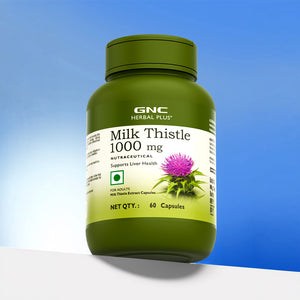



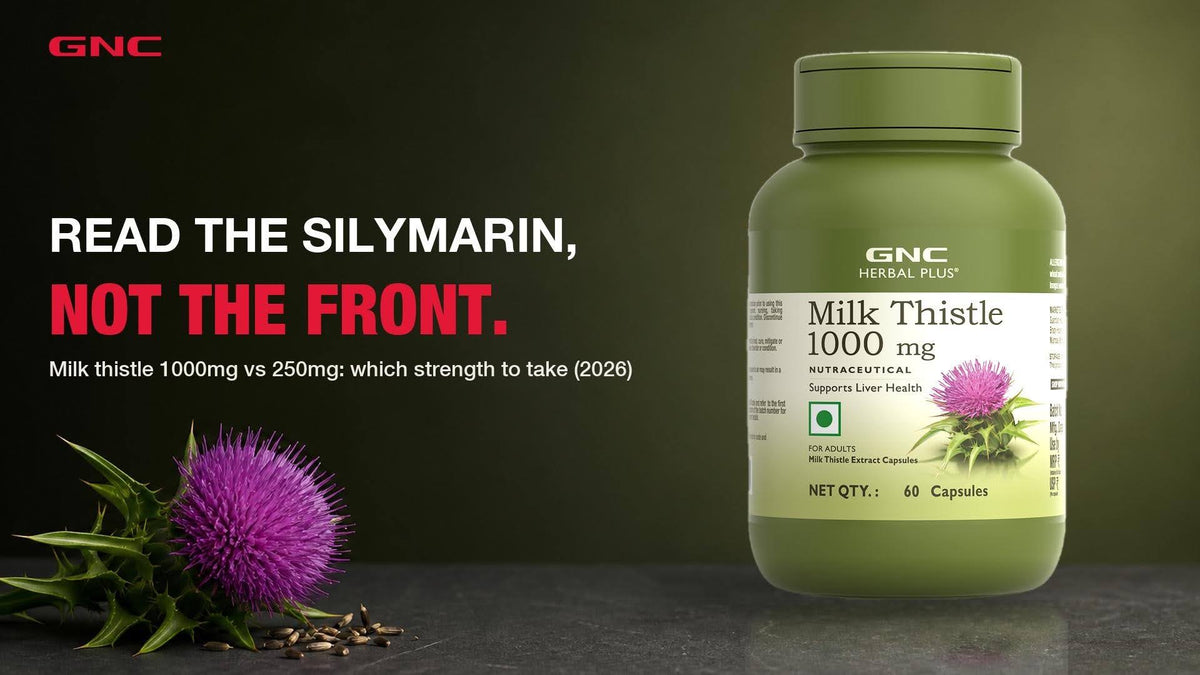
Quick Answer: Choose a milk thistle strength by the silymarin per day on the label, not the bigger number on the front, which usually shows extract weight. Silymarin is the group of plant compounds researchers study. GNC Herbal Plus Milk Thistle 1000mg, for example, states 800mg silymarin per serving, and that is the figure to compare.
You're looking at two packs of milk thistle. One says 250 mg on the front. The other says 1000mg. The bigger number looks like the stronger choice, doesn't it?
Not quite.
That front figure tells you how much plant powder went into each capsule, but it says nothing about how much of that powder is the part researchers actually measure when they run a study. That second figure sits further down the label, in a line you have probably skimmed past.
So this piece works as a checklist: the lines to read on any milk thistle label, in order, so you can compare two packs on the same terms. No promises about your liver, just label reading and what the research used.
Does the mg on the front of the pack tell you the silymarin?
The milligram figure on the front of a milk thistle pack is usually the weight of the extract in each capsule, not the silymarin inside it.
Two terms, explained once.
An extract is a concentrated powder made from the milk thistle plant, the active powder in your capsule.
Silymarin is the group of plant compounds inside that extract. The US National Center for Complementary and Integrative Health (NCCIH) describes silymarin as the main component of milk thistle extract, a mixture of compounds rather than a single one.
Here's the thing. Two capsules can carry the same extract weight and different amounts of silymarin. Which one would you rather know about?
Check 1: find the front number and read it as extract weight. It is the starting point for the arithmetic, not the answer.
So "1000mg vs 250mg" compares powder, not the compounds studies use.
What does standardised to 80 percent mean on a milk thistle label?
"Standardised to 80 percent" means each batch of the extract has been tested and adjusted so that 80 parts in every 100 of it are silymarin.
Standardised is a promise of consistency. Plants vary from harvest to harvest, so a maker measures the silymarin in the extract and adjusts it to a fixed share, which the label then states as a percentage or as a silymarin figure in milligrams.
The arithmetic takes one step
Once the percentage is on the label, multiply the extract weight by it. The table uses 80 percent as a general example, not any one product's figure.
| Extract weight on the front | Standardised to | Silymarin (multiply the two) |
|---|---|---|
| 250 mg | 80 percent | 200 mg |
| 1,000 mg | 80 percent | 800 mg |
| Any figure | Not stated | Unknown from the label |
Read that last row twice.
When the label gives no percentage
If a pack states neither a percentage nor a silymarin figure, you cannot work out the silymarin at all.
NCCIH notes that when milk thistle supplements have been tested, the silymarin found has sometimes differed substantially from what the label stated. A clearly stated silymarin line is the least a label should give you.
Check 2: look for "standardised to" and a percentage. Multiply the extract weight by that percentage.
Check 3: or look for silymarin stated in milligrams. Some labels skip the percentage and print the silymarin figure directly, which saves you the arithmetic.
What doses did the trials use, and what did they find?
In a 2012 trial published in JAMA, silymarin at 420 mg or 700 mg three times a day for 24 weeks did no better than a placebo.
The 2012 JAMA trial
JAMA is the Journal of the American Medical Association, and the trial was led by Michael Fried. The Fried trial enrolled 154 people with long-term liver disease. A placebo is a dummy capsule with nothing active in it, so the comparison shows whether silymarin itself did anything.
The researchers tracked ALT, a routine blood test that measures a liver enzyme. Silymarin did not move ALT any more than the placebo did at either dose, and the authors themselves described both doses as higher than customary.
A bigger dose showed no extra benefit
A higher silymarin dose did not show a benefit in that trial. Bigger is not automatically better.
The Fried trial is one study, in one group of people, and it gives no advice about any illness. NCCIH sums up the wider research in a similar way: trials of milk thistle in liver conditions have been conflicting or too limited to draw conclusions, and two NCCIH-funded studies showed no benefit from silymarin.
What do NCCIH and Mayo Clinic say about dose and safety?
NCCIH and Mayo Clinic's milk thistle page give no standard daily dose, which leaves you two honest reference points: the trial doses above and the directions on your pack.
NCCIH says milk thistle taken by mouth appears to be well tolerated, with bloating, nausea and gas the most common side effects. It also flags allergy risk for people sensitive to ragweed, chrysanthemum, marigold or daisy.
Mayo Clinic describes it as generally safe and lists possible interactions with medicines. These include diabetes medicines and drugs processed by an enzyme called CYP2C9, such as warfarin and diazepam.
If you take a regular medicine, or you're under a doctor's care, talk to your doctor before you start.
250 mg or 1000 mg: which strength fits your routine?
Neither strength is right by default. The better fit is the pack that states its silymarin clearly and whose directions you'll actually follow every day.
Daily silymarin is the number to compare
Compare the silymarin you take per day, not the number on the front of the pack. It is a routine question, not a strength contest.
A lower-strength capsule usually means more capsules in a day, and a higher-strength capsule usually means fewer, so the capsule count alone cannot settle it. The daily silymarin is the silymarin per capsule multiplied by the number of capsules the label asks for.
Do not read a higher figure as a better one. And do not combine two milk thistle products to reach a bigger total: the directions on your pack are the amount that product was designed around.
The five-line label checklist
Run any two packs through these checks, in order:
- Front number: read it as extract weight.
- Standardisation: find the percentage, or the silymarin in milligrams.
- Serving size: check how many capsules make one serving. A silymarin figure "per serving" may cover more than one capsule.
- Daily directions: note how many servings the label asks for in a day, and whether it wants them with food or before it.
- Your situation: medicines, allergies, pregnancy or breastfeeding. NCCIH says little is known about safety in pregnancy or while breastfeeding.
After those five checks, the "250 mg or 1000 mg" question usually answers itself.
For the wider picture of why people take milk thistle at all, the benefits people most often ask about are covered in a separate post.
With a meal or before it: what labels ask for
Labels differ. Some ask for milk thistle with a meal and others before meals, so follow the directions printed on the pack in your hand.
Morning or night?
The time of day is often left open. What a label is more likely to specify is food, and that's the line to follow.
There is a practical reason to respect it. The most common side effects NCCIH lists are digestive: bloating, nausea and gas.
GNC's 1000mg product page asks for its capsules with a meal.
Whatever your pack says, pick one fixed moment in the day and keep it. A capsule tied to lunch is harder to forget than one taken "sometime today".
How does GNC Herbal Plus Milk Thistle 1000mg state its silymarin?
The product page for Herbal Plus Milk Thistle 1000mg says "Standardized to provide 800mg Silymarin per serving" and "Take 2 capsules daily with a meal". Here is the checklist run on that page.
Check 1: the page lists 1000mg as the strength and milk thistle (Silybum marianum) extract as the first ingredient, but does not say what the 1000mg measures. It is not the silymarin.
Checks 2 and 3: the page gives silymarin as 800mg per serving and states no percentage. That's the figure to compare.
Check 4: the directions are 2 capsules daily with a meal. The page does not say how many capsules make one serving, so check the pack.
Herbal Plus Milk Thistle 1000mg is also 100% vegetarian.
If you train hard, our look at bodybuilding and liver health covers the wider picture, and our complete guide to Herbal Plus Milk Thistle 1000mg goes further.
The Bottom Line
The strength printed on the front of a milk thistle pack usually tells you the powder, not the silymarin.
The question that matters is how much silymarin you take each day, and your label gives it away in order: the standardisation line or silymarin figure, then the serving size, then the daily directions.
The research adds one useful limit. The 2012 Fried trial in JAMA used silymarin doses higher than customary and found no benefit over a placebo. Neither NCCIH nor Mayo Clinic sets a standard dose. So a bigger number, on its own, is not a reason to choose a pack.
Read the label in order. Follow its directions. And if you take any regular medicine, check with your doctor first.
Frequently Asked Questions
Is 1000 mg of milk thistle too much?
Not necessarily. A 1000 mg front figure usually describes the extract, not the silymarin, so it says little on its own. Compare the silymarin per day on the label and follow the pack's directions, and check with a doctor first if you take regular medicines, because Mayo Clinic lists possible interactions.
How much silymarin is in a 1000 mg capsule?
The silymarin in a 1000 mg capsule depends on the standardisation printed on the label, not the front figure. GNC's page for its 1000mg product states 800mg silymarin per serving, with directions of 2 capsules daily, so check the pack for the serving size.
Can you take milk thistle every day?
Most labels give daily directions, and the 2012 JAMA trial dosed people daily for 24 weeks. NCCIH says milk thistle appears to be well tolerated, with digestive upsets the most common side effect, so stick to your pack's directions and speak to a doctor if you're pregnant, breastfeeding or on medicines.
When in the day should you take it?
Your label often leaves the time of day open and specifies food instead: with a meal or before meals, depending on the product. Follow your own pack, then anchor the capsules to one daily meal so the habit sticks.