











Quick Answer: A supplement is third-party tested when an independent laboratory, not the manufacturer, screens a finished batch and publishes the result. In sports nutrition the three marks that carry weight are NSF Certified for Sport, Informed Choice or Informed Sport, and USP Verified. Each one certifies a batch, never a brand.
You turn the tub over and find a small logo you don't recognise, with the words lab tested beside it. You already know to prefer products an independent laboratory has checked. What you don't know is which logos actually mean that.
Three programmes dominate this space, and they do not check the same things. Here's what each mark covers, what a Certificate of Analysis is, and how to check one specific tub yourself.
What does third-party tested actually mean?
Third-party tested means an independent laboratory, one that neither makes nor sells the product, tests a sample from a finished batch and reports what it found. The company pays for the test, but it doesn't run it.
That distinction is the whole point. In-house quality control examines the same batch the company is trying to sell. An outside laboratory has no stake in the answer, and that is the whole value of it.
These programmes exist because of what testing kept turning up. A 2004 study in the International Journal of Sports Medicine (Geyer et al.) analysed 634 supplements bought in 13 countries, and 94 of them, 14.8%, contained anabolic androgenic steroids that were not declared on the label.
The pattern held nearly two decades later. A 2021 paper in the Journal of Sports Science and Medicine (Duiven et al.) screened 66 high-risk sports nutrition products bought from Dutch web shops, and 25 of them, 38%, contained undeclared doping substances.
What the laboratory is actually screening for
The screens are based on anti-doping lists, not food supplement lists. Informed Choice and Informed Sport analyse for more than 285 banned substances. NSF Certified for Sport screens for 290 substances across stimulants, narcotics, anabolic steroids, diuretics, beta-2-agonists and masking agents, drawn from the World Anti-Doping Agency list and the major sports bodies.
So a banned-substance mark answers one question well: is there anything in here that should not be there? It isn't a nutrition audit, and that's the part most people get wrong.
NSF Certified for Sport, Informed Choice and Informed Sport: what each covers
All three screen finished sports nutrition products for substances banned in sport. They differ in how often a batch is tested, and in what gets inspected beyond the product itself.
NSF reaches furthest beyond the tub. Alongside the substance screen, its programme reviews the formulation and the label, inspects the production facility and its suppliers, and keeps monitoring the product after the certificate is issued.
Where Informed Choice and Informed Sport differ
Informed Sport tests every batch before release. Informed Choice tests at least twelve batches a year, purchased blind from shops and websites, so the tub you buy may not itself have been through the laboratory.
LGC runs both programmes with the same ISO/IEC 17025 accredited methods and the same substance list. The difference is coverage, not method. LGC launched Informed Sport in 2008 with UKAD, aimed at elite athletes and anyone subject to drug testing.
Informed Choice, established in 2007, is a retail monitoring programme aimed at active people who are not under doping control. If you compete under an anti-doping code, that gap decides which mark you need. If you don't, either mark tells you the same useful thing.
USP Verified and what it checks that the others do not
USP Verified is not a sport mark. The United States Pharmacopeia programme confirms that a supplement contains the ingredients on its label, in the stated amounts, and that it dissolves or disintegrates properly.
It also sets limits for contaminants, among them heavy metals, pesticides, dioxins, furans, PCBs and microorganisms. The disintegration test matters because a tablet that never breaks down cannot release what the label promises.
Earning the mark takes a manufacturing facility audit, a review of quality control and manufacturing documentation, and laboratory testing of samples against the label. USP then repeats the audits, the documentation review and off-the-shelf testing every year.
USP is direct about the limit of all this. Its programme verifies identity, amounts, purity and release. It does not comprehensively address whether a supplement works.
What a Certificate of Analysis is, and how to read one
A Certificate of Analysis, or COA, is the laboratory report for one specific batch, which includes such information as product name, lot or batch number, date, tests carried out, and their findings in terms of the product's required specifications.
Four things decide whether a certificate of analysis is worth anything: which laboratory issued it, which batch it covers, which tests were run, and whether the batch number on the report matches the one printed on your tub.
That last check is the one people skip, and it's the one that settles the question. A report for one lot says nothing about the next lot, which is exactly why the serious programmes certify batches rather than brands.
Read the method, not just the result. LGC runs Informed Choice and Informed Sport out of an accredited anti-doping laboratory using ISO/IEC 17025 methods, which is what the professional sports bodies ask for.
Why "lab tested" on a label is a different claim
Lab tested printed on a pack is a description, not a certification. There's no register behind it, no batch listing for you to search, and no independent body standing behind the words.
Label accuracy has been measured, and the findings are worth knowing. A 2023 case series in JAMA Network Open (Cohen et al.) analysed 57 sports supplements listing one of five botanical ingredients, and 23 of them, 40%, contained no detectable amount of the labelled ingredient. Only 6 of the 57 came within 10% of the labelled quantity.
Indian law sets a floor here rather than a ceiling. The FSSAI Labelling and Display Regulations, 2020 govern what a pack must declare, including the ingredient list, the nutritional information and the lot or batch identification that every COA hangs off.
A compliant label and a tested batch are two separate things. The label states what the company says is inside. A certification mark, tied to a lot number you can look up, is the part somebody else checked.
How to check a batch yourself
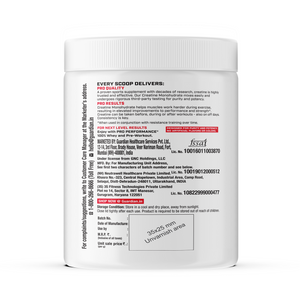
Start with the pack. You'll find the batch or lot number printed or stamped near the expiry date, and that number is what you search in the certifier's own database rather than trusting the logo on its own.
Informed Choice and Informed Sport both publish searchable batch listings, and Informed Sport adds a mobile app for the same job. NSF publishes an online database and an app with a barcode scanner for Certified for Sport products.
Some brands publish the reports directly. The batch lab reports page on guardian.in works the same way: every batch is independently tested, and you match the batch number on your pack with the corresponding lab report.
Authenticity is a separate question from screening, and both are worth answering. The code on the pack lets you confirm a pack is a genuine GNC unit, which tells you nothing about banned substances, and a batch report tells you nothing about whether the pack is real.
GNC Pro Performance Creatine Monohydrate: what the Informed Choice mark covers
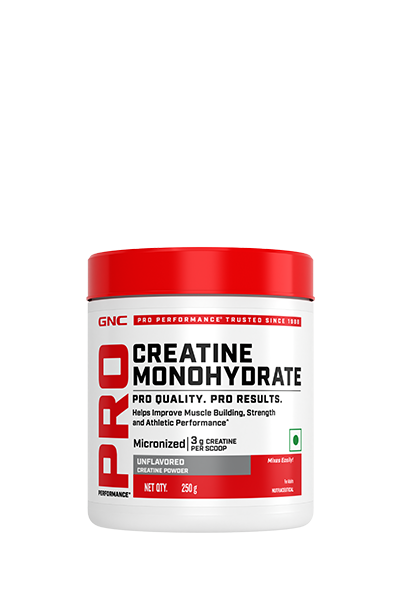
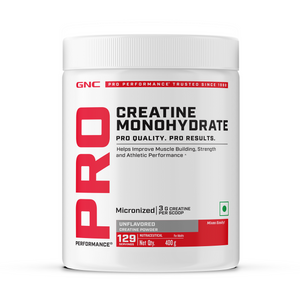
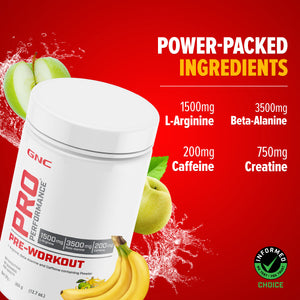
GNC Pro Performance Creatine Monohydrate is Informed Choice Certified and free from any harmful banned substances. That is a batch-level claim under the Informed Choice programme run by LGC, and it belongs to this product rather than to everything on the shelf.
Read that mark against what you now know. Informed Choice is the retail monitoring route, so at least twelve batches a year are bought blind and screened for more than 285 substances banned in sport. That's a contamination check, and nothing wider than that.
What the mark does not tell you
The Informed Choice mark says nothing about how well creatine works, or about how much of it you get. The label carries that part. Each serving delivers 3 g of creatine monohydrate, and the container holds 83 servings. Those figures, plus the batch number stamped on the pack, are what a laboratory report gets matched against.
Scope is set product by product, so the pack in front of you is the one to read. The creatine range and the whey protein range each state their position on their own product pages, and why banned-substance testing matters on creatine goes deeper on one of those categories.
The Bottom Line
A mark certifies a batch, not a brand, and that single idea does most of the work here. NSF Certified for Sport and Informed Sport test lot by lot. Informed Choice samples from retail across the year. USP Verified checks identity, amounts, contaminants and release rather than doping.
None of these marks tells you whether a supplement works. That answer sits in the research on the ingredient, not on the pack.
Supplements support a balanced diet rather than replace it. If you have a medical condition, are pregnant, or take regular medication, consult your doctor before starting anything new.
Frequently Asked Questions
Does third-party testing prove a supplement works?
No. These programmes check what's in a product, not what it does. USP states that its verification programme does not comprehensively address efficacy, and the banned-substance marks make no claim about results. Effectiveness comes from research on the ingredient itself.
How often is a certified product re-tested?
Re-testing frequency is set by the programme. Informed Sport screens every batch before release, Informed Choice buys and tests at least twelve batches a year, NSF Certified for Sport works lot by lot with ongoing monitoring, and USP repeats its audits and off-the-shelf testing annually.
What should I do if a brand publishes no lab report?
Search the certifier's own database using the batch number on the pack. Informed Choice, Informed Sport and NSF each publish a searchable register of certified products and batches. So you can confirm a mark yourself even when the seller publishes no report.
Which GNC products carry a third-party test mark?
Scope is set product by product, so read the product page for the pack you are buying. GNC Pro Performance Creatine Monohydrate is Informed Choice Certified and free from any harmful banned substances. Batch lab reports are published separately and matched by batch number.