











Quick Answer: Vegetarian adults in India need 0.83 g of protein per kg of body weight a day, the ICMR-NIN recommended daily allowance. That's about 50 g at 60 kg, and regular training raises it to 1.4 to 2.0 g per kg. Muscle gains tend to level off near 1.6 g, and mostly plant plates may need the upper end.
You had dal and rice for lunch. Paneer for dinner, curd on the side, a few rotis along the way.
It feels like a lot of protein.
Is it?
For most vegetarian plates in India, the honest answer is: enough for the baseline, rarely enough for training. What's missing usually isn't one food. It's a number you've probably never worked out, and a breakfast that carries almost none of it.
Below, you'll find that number for your goal, then an ordinary vegetarian day tallied gram by gram, so you can see where yours falls short.
The baseline is 0.83 g for every kilo you weigh
Multiply your body weight in kg by 0.83. That's the recommended dietary allowance for healthy Indian adults set by the ICMR-National Institute of Nutrition in its 2020 requirements, and it counts all the protein you eat in a day, from every source.
If you weigh 60 kg, your baseline is about 50 g, while ICMR-NIN's own reference adults land at 54 g for a 65 kg man and 45.7 g for a 55 kg woman.
Think of it as the baseline. ICMR-NIN applies the same 0.83 g whether your work is light or heavy, and it isn't built around gym training.
It isn't designed for you if you lift four days a week.
Why a cereal-heavy plate nudges it to 1 g
The same ICMR-NIN note adds a condition that matters on Indian plates. Where most of your protein comes from cereals and its quality is low, the requirement rises to 1 g per kg a day.
The fix it suggests is proportion, not supplements. ICMR-NIN puts a good cereal-legume-milk balance at 3:1:2.5, which means three parts grain, one part dal or pulses and two and a half parts milk or curd.
How much more do active adults need?
If you train regularly, plan for 1.4 to 2.0 g of protein per kg a day. That's the range the International Society of Sports Nutrition gives for most exercising people in its 2017 position stand on protein and exercise, published in the Journal of the International Society of Sports Nutrition.
At 60 kg, that's 84 to 120 g, nearly double the baseline.
Where you sit in that range depends on how often you train, how hard you push and whether you're eating in a calorie deficit at the same time.
Two yoga classes a week? Near the bottom. Heavy lifting five days a week sits nearer the top, and the same ISSN stand notes that trained people cutting calories may need more still to hold on to lean mass.
These are commonly used ranges from the research, not a prescription.
Building muscle: where extra protein stops paying
For muscle gain, about 1.6 g per kg a day is where the benefit tends to flatten. A 2018 meta-analysis in the *British Journal of Sports Medicine* by Morton and colleagues pooled 49 trials and 1,863 people doing resistance training.
Protein beyond roughly 1.62 g per kg a day added no further gains in lean mass, on average. Because that estimate was uncertain, the authors suggested up to about 2.2 g for people who want the most gain.
So more isn't automatically better.
Does eating mostly plants change the maths?
A little, and in a predictable direction: aim for the upper half of your range. Plant proteins are, on average, slightly less digestible than milk protein, and many carry less leucine, the amino acid most closely tied to switching on muscle building.
A 2015 review in The Journal of Nutrition by van Vliet, Burd and van Loon laid out both reasons, along with two suggested fixes: eat a bit more protein, and combine your sources.
That's why dal with rice works.
Legumes run short on methionine and grains run short on lysine, so a plate that carries both gets each amino acid from the food richer in it. The scoring behind this is in our explainer on PDCAAS and protein quality.
Can plants build muscle?
Yes, even without animal protein.
A 2021 trial in Sports Medicine by Hevia-Larrain and colleagues put 19 vegans and 19 omnivores through 12 weeks of resistance training, with both groups brought up to 1.6 g per kg. Leg lean mass rose by the same 1.2 kg in each group.
In these young men new to lifting, source mattered far less than hitting the number.
A vegetarian day, tallied gram by gram
An ordinary dal-roti day gives a 60 kg adult about 49 g of protein. That covers the ICMR-NIN allowance almost exactly, and leaves you about 35 g short of the bottom of the training range (84 g at 1.4 g per kg).
The figures use raw-ingredient protein values from ICMR-NIN's Indian Food Composition Tables (IFCT 2017). Your recipes and portions will shift them, so read every line as approximate.
The same day, eaten two ways
Where the typical day falls short
Curd is counted at milk's value, as ICMR-NIN's 2024 dietary guidelines do.
Look at breakfast. Eleven grams. Most of the day's protein arrives at lunch and dinner, while the morning, the meal that follows the longest stretch of the day without food, runs almost empty.
The rebuilt day adds no supplement at all: poha becomes besan, paneer joins lunch, chana fills the evening and soybeans go into dinner, and the total climbs to about 83 g.
That lands just under the bottom of the training range (84 g at 1.4 g per kg) and about 13 g short of 96 g (1.6 g per kg).
The checklist: four gaps to close before you buy anything
Run your own day against this list first. Food closes most of the gap on its own.
- Put 15 to 20 g at breakfast. Besan chilla, moong cheela, paneer paratha or curd with roasted chana all carry more than poha or bread.
- Spread it, don't stack it. A 2014 study in The Journal of Nutrition by Mamerow and colleagues found about 30 g at each of three meals gave 25% higher 24-hour muscle protein synthesis than the same total skewed to dinner.
- Count your dal honestly. A thin katori from 30 g of dry toor dal gives about 6.5 g. Make it thicker, or have a second one.
- Use paneer and soy on purpose. ICMR-NIN's IFCT 2017 puts paneer near 19 g and dry soybean near 36 g per 100 g.
When does a scoop actually make sense?
A protein powder makes sense once food has done the heavy lifting and a steady gap remains. In the rebuilt day, that gap is the last 13 g towards 96 g, the meta-analysis level of 1.6 g per kg.
A scoop is worth considering if you:
- aim above 1.4 g per kg and your meals stall short most days
- have a breakfast window too rushed for chillas or curd
- train late, so dinner can't carry a full meal's protein
- eat vegan, which takes paneer and curd off your plate
On days your food already meets the number, you don't need one, and it should never replace a meal. Protein powder adds to a varied diet rather than standing in for it. If you have a kidney or other medical condition, are pregnant, or take regular medication, consult a doctor before you raise your protein intake.
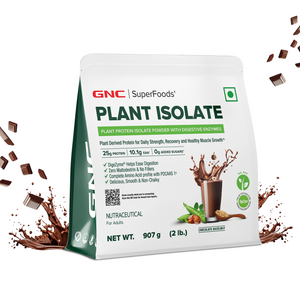
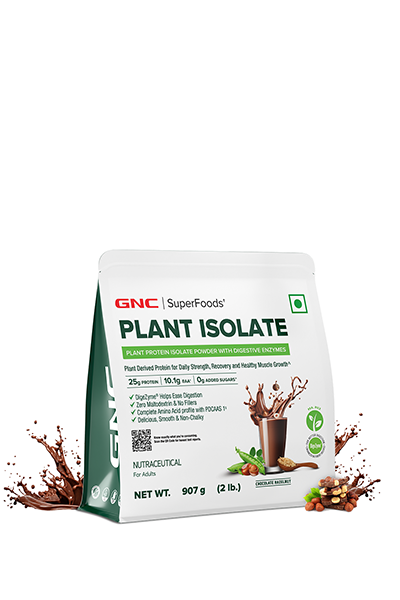
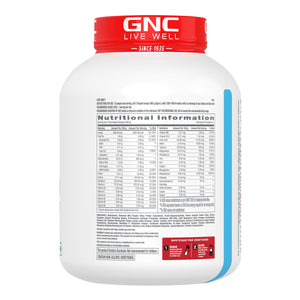
GNC Superfood Plant Isolate, worked through this guide
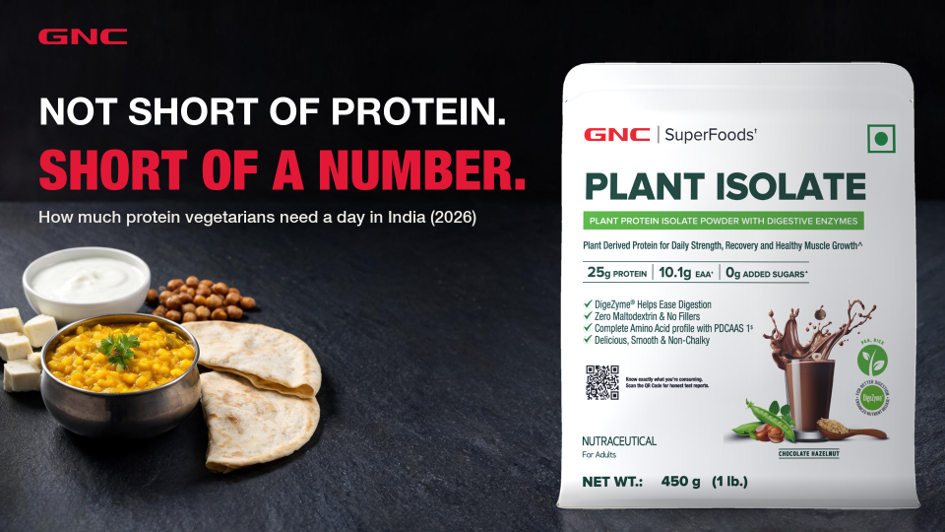
Here's one plant powder, read against the checks above. GNC Superfood Plant Isolate carries 25g of protein per scoop, which alone covers the rebuilt day's shortfall nearly twice over.
It answers the plant-plate question the way dal and rice do, by combining sources. The protein is a blend of pea protein isolate and brown rice protein that supplies all nine essential amino acids, about 10.1g EAAs per scoop.
It's dairy-free and soy-free, so it suits a vegan day with no paneer or curd to lean on. The blend also includes DigeZyme, a multi-enzyme complex, for easier digestion.
Mix one scoop with 350 to 400 ml of water or plant milk. One serving a day is the direction on the product page, which makes it the top-up this guide describes rather than a second meal. You can compare flavours across the plant protein range.
The Bottom Line
Vegetarians in India aren't short of protein sources. They're short of a number.
Your baseline is 0.83 g per kg, 1 g if your plate leans on cereals, and 1.4 to 2.0 g per kg if you train. Around 1.6 g per kg is where muscle gains usually stop improving.
Then look at when you eat it, because breakfast is almost always your weakest meal, and a day spread evenly across three meals does more for your muscles than one that saves everything for dinner.
Food first. A scoop only for the gap that's left.
More on the foods themselves sits in this guide to proteins in the Indian diet.
Frequently Asked Questions
Do women and men need different amounts of protein?
Not per kilo. ICMR-NIN sets the same 0.83 g per kg for adult women and men, so totals differ only because body weights do. Its reference figures give 45.7 g a day for a 55 kg woman and 54 g for a 65 kg man. Training raises both the same way.
How much protein is in one katori of dal?
Roughly 5 to 7 g. A katori made from 30 g of dry toor dal gives about 6.5 g, and moong dal slightly more, based on IFCT 2017 values. Thin, watery dal carries less, and doubling the dry dal, or adding paneer or soy to the meal, lifts it much more.
Do vegans need more protein than vegetarians?
Often a little more. Without curd, milk and paneer, a vegan plate leans harder on cereals and legumes, which are less digestible on average. Aim for the upper half of your range, combine pulses with grains, and use soy, one of the densest plant sources.
How much protein should one meal carry?
About 0.25 g per kg of body weight, according to the ISSN, or 20 to 40 g in absolute terms. At 60 kg, that's about 15 g a meal. Three meals of 25 to 30 g each, plus a protein snack, get you close to a training target.