











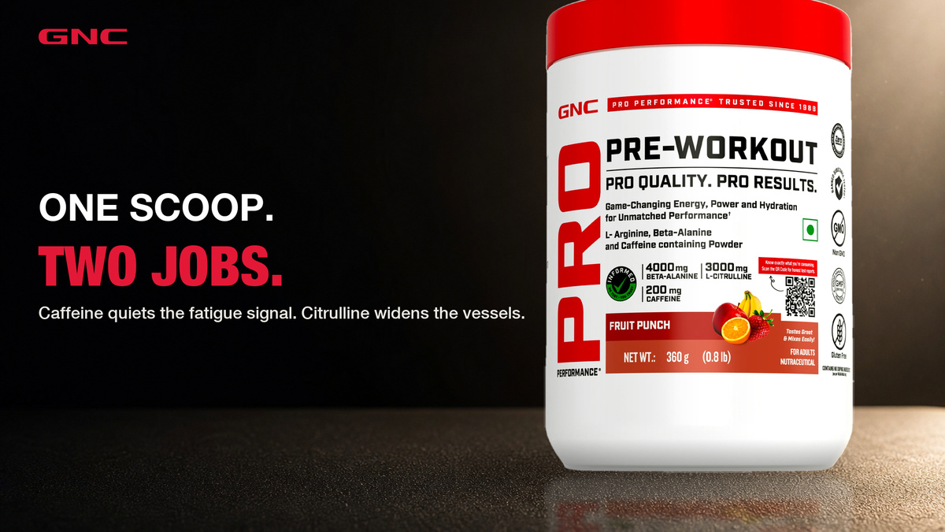
Quick Answer: A pre-workout is really two separate tools in one scoop: caffeine, which produces the energy, and citrulline, which produces the pump. Caffeine mutes the brain's fatigue signal. Citrulline widens your blood vessels so more blood reaches the muscle being trained.
You scoop it, wait twenty minutes, and two things happen. Your head sharpens. Your arms feel fuller. Most people assume one ingredient did both jobs.
It didn't. The sharpness and the fullness come from two different molecules, working on two different systems, on two different clocks. Once you can see that split, an ingredient list stops being a wall of names and starts being a set of numbers you can judge.
Here's what actually happens inside the body, and what it means for the tub you reach for in the pre-workout aisle.
Caffeine: what actually produces the energy
Caffeine doesn't give you energy. It blocks the chemical that tells your brain you are tired, which is a very different thing.
Adenosine builds up in your brain across the day and across a hard session. When adenosine docks onto its receptors, neural firing slows, and that slowdown is what registers as fatigue. Caffeine's molecular shape is close enough to adenosine that it sits in those same receptors without switching them on.
So the alertness is a subtraction, not an addition. The tiredness signal goes quiet, and whatever was underneath it comes through.
The International Society of Sports Nutrition position stand on caffeine (Guest et al., *Journal of the International Society of Sports Nutrition*, 2021) reports consistent performance improvements at 3 to 6 mg per kilogram of body mass.
That review puts the most commonly used timing at about 60 minutes before exercise. It also notes that very high intakes, around 9 mg per kilogram, bring a high rate of side effects without adding benefit.
Why the same scoop hits two people differently
Genetics, mostly. That ISSN review attributes much of the person-to-person difference to genetic variation in how caffeine is metabolised, alongside how much caffeine you already drink in a normal week.
Two lifters can take an identical dose and report opposite experiences. Neither of them is imagining it, and neither pack is wrong. If a standard scoop leaves you jittery rather than sharp, the dose is the variable to move.
Citrulline: what actually produces the pump
Citrulline produces the pump by raising nitric oxide, and nitric oxide relaxes the walls of your blood vessels so more blood reaches the muscle being trained.
The route is indirect, and that's the interesting part. L-citrulline is absorbed, then converted onward into L-arginine. Arginine is the raw material the enzyme nitric oxide synthase uses. Nitric oxide relaxes vascular smooth muscle, vessels widen, flow rises, and the working muscle swells.
Why not just swallow arginine instead
Because most of it never arrives. Schwedhelm and colleagues, in the *British Journal of Clinical Pharmacology*, 2008, report that oral L-arginine is broken down by intestinal arginase before it reaches the bloodstream, so much of the dose is lost on the way.
L-citrulline takes a different route. It is absorbed intact and converted to arginine afterwards. In twenty healthy participants, citrulline raised plasma arginine dose-dependently, more effectively than arginine itself, and urinary nitrate and cyclic GMP rose alongside it.
The performance evidence follows the same shape. Bailey and colleagues, in the *Journal of Applied Physiology*, 2015, gave ten healthy men 6 g a day of citrulline or arginine for seven days. Citrulline lowered blood pressure, sped up oxygen uptake kinetics during severe-intensity cycling, and increased the total work completed. Arginine did none of those things.
Why two pre-workouts with the same ingredients feel different
Two tubs can list the same ingredients and feel nothing alike, because the dose decides the effect and the name does not.
An ingredient list tells you what is present, not how much. A caffeine amount that suits a 60-kilogram lifter is a different experience for a 90-kilogram one, because the researched range is set against body mass rather than per scoop.
Then there is the clock. Caffeine runs on the clock of absorption, roughly the hour before you lift, and citrulline works within a single serving too.
Beta-alanine does not. It is the third mechanism in most formulas, and much the slowest. The ISSN position stand on beta-alanine (Trexler et al., *Journal of the International Society of Sports Nutrition*, 2015) concludes that four weeks of 4 to 6 g daily significantly raises muscle carnosine.
Muscle carnosine then buffers pH inside the muscle. One serving before one session does not do that. The beta-alanine benefit is built over weeks, never borrowed on the day.
The proprietary-blend problem
A proprietary blend gives one combined weight for a group of ingredients, so the tub tells you what is inside but never how much of each.
That matters more here than in most categories, because everything above is dose-dependent. A caffeine figure you can't read is one you can't match to your body mass. A citrulline amount that isn't printed can't be lined up against the quantities the trials actually used.
So the check is a simple one, and it belongs to the reader: look for a per-ingredient amount next to each active on the pack. India's Labelling and Display Regulations, 2020 govern what a packaged food label has to carry in this country, so the pack settles the question, not the front-of-tub copy.
A tub that prints per-ingredient amounts lets you do the arithmetic in this article. A blend total does not, and that's worth knowing before you buy rather than after.
Stim and non-stim: which suits which session
Stim formulas carry caffeine and suit sessions where focus and output matter. Non-stim formulas leave the caffeine out and suit late training, or days when you have already had plenty of coffee.
The split is about the stimulant alone. Citrulline sits comfortably in both shapes, because nitric oxide has nothing to do with adenosine. You can have the fullness without the buzz.
Why sleep decides the stim question
Sleep is the practical reason the choice exists at all. The ISSN caffeine review links caffeine to adverse effects on sleep in some people, and the effect varies with genetics and habitual intake. So if you train at nine at night, the stimulant is the part worth reconsidering, not the whole formula.
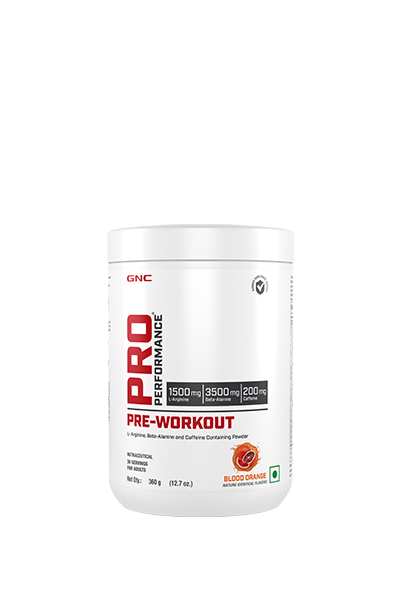
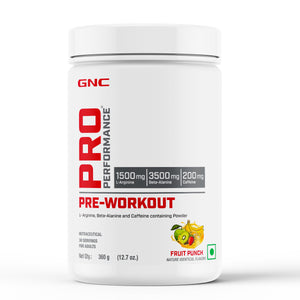
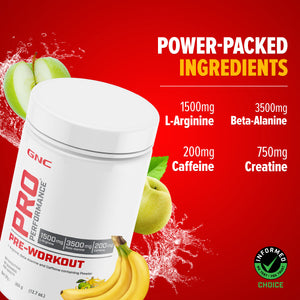
GNC Pro Performance Pre-Workout: the same three questions, on one label
GNC Pro Performance Pre-Workout is a stimulant formula written for training days, and it answers the timing question this article has been circling.
One serving is 12 grams, mixed into 250ml to 300ml of water. Take it 30 to 45 minutes before you train, which sits inside the caffeine absorption window. The label keeps it to training days only, and away from late evenings.
It's written for people training two hours or more, endurance athletes, and anyone wanting to be ready for the next session sooner.
Our guide to pre-workout timing, dosage and best practices covers how much to take and when, and what a pre-workout supplement does walks through the ingredient groups.
The Bottom Line
A pre-workout is not one effect. It is a stack of separate mechanisms running on separate clocks, and the amount panel is where a tub tells you which of them it will actually deliver.
Caffeine subtracts fatigue by occupying adenosine receptors, and the useful range is set against your body mass. Citrulline adds flow by raising nitric oxide, and it does that where arginine largely fails, because far more of it survives the trip. Beta-alanine buffers acid inside the muscle, and only after weeks of daily use.
Read the amounts, match them to your body and to the session you are about to do, and the rest follows. Supplements support a balanced diet rather than replace it, so anyone with a medical condition, who is pregnant, or who takes regular medication should consult a doctor before starting one.
Frequently Asked Questions
How long before a workout should I take a pre-workout?
About 30 to 45 minutes for most stimulant formulas, which is the window our own pack specifies. The ISSN caffeine review reports 60 minutes before exercise as the most commonly studied timing. Follow the pack in front of you rather than a general rule.
Why do I get a tingle from pre-workout?
Beta-alanine causes it, and the sensation is called paraesthesia. The ISSN position stand (Trexler et al., 2015) lists paraesthesia as the only reported side effect and notes that smaller divided doses reduce it. It's a sensation, not a signal that the dose is working.
Can I train without a pre-workout?
Yes. Nothing in a pre-workout lifts the weight for you or builds the muscle. It changes how tired you feel and how much blood reaches the muscle. Sleep, food and a sensible programme do far more, and no scoop stands in for them.
Is a daily pre-workout a problem?
Most stimulant formulas are written for training days only, which is what our own pack says. Habitual caffeine intake changes how you respond, according to the ISSN review, and caffeine disturbs sleep in some people. Keep it to the days you actually train.
Should I look for citrulline or arginine on the label?
Citrulline. Schwedhelm and colleagues (2008) found that intestinal arginase degrades oral arginine before much of it reaches the bloodstream. Bailey and colleagues (2015) then showed citrulline producing an exercise benefit in a trial where arginine produced none.