












Quick Answer: Neither algae oil nor fish oil is better for everyone: both supply DHA, and fish oil also supplies EPA, which only some algae oils do. A 2025 trial in 74 adults found algal oil no worse than fish oil at raising blood omega-3 levels, so compare the milligrams of EPA and DHA per capsule.
You've decided to add an omega-3. Then you open the shopping page and find two kinds of capsule. One says fish oil. The other says algae.
If you're vegetarian, the choice feels made for you. If you eat fish, it's less clear, because you've probably heard that fish oil is the original and assumed that anything grown from algae must be a weaker copy of it. Is the plant version a compromise? Does fish oil carry something algae can't?
Here's the thing. Both oils are chasing the same two molecules.
What changes from one capsule to the next is how many of those molecules it holds, what the shell is made of and how well the oil keeps on your shelf. Those are the three things this piece walks through, one at a time, with the studies that actually put algae and fish side by side.
Two oils, the same two omega-3s
Algae oil and fish oil can supply the same two kinds of omega-3, EPA and DHA. Algal oils always carry DHA, but only some carry EPA, according to the US National Center for Complementary and Integrative Health (NCCIH).
- EPA (eicosapentaenoic acid) is one of the two omega-3 fats studied most in people.
- DHA (docosahexaenoic acid) is the other, and it is the one every algae oil supplies.
Most talk of algae oil benefits is talk about these two fats, and our guide to EPA and DHA covers what each one does.
Fish get their omega-3s from algae in the first place
Fish do not make omega-3s themselves. As our EPA and DHA guide explains, microalgae at the base of the marine food chain make them, and fish build up EPA and DHA by eating their way up that chain.
Algae oil, often sold as algal oil, comes straight from those microalgae: tiny single-celled organisms. Fish oil comes from the fish.
NCCIH's own wording is careful: algal oils are a vegetarian source of DHA, and some also contain EPA.
That word "some" matters.
A plant-based omega-3 is not automatically short on EPA, and it is not automatically rich in it either. You find out which kind you are holding on the label, not on the front of the pack.
How much EPA and DHA does each capsule carry?
Per capsule, the two oils can carry different splits of EPA and DHA, and the label lines for each are the only reliable way to tell. The capsules used in a 2025 trial by Bailey and colleagues show how far apart two products can sit.
| Per capsule, 2025 trial | Algal oil | Fish oil |
|---|---|---|
| EPA | 164 mg | 289 mg |
| DHA | 443 mg | 205 mg |
| Capsules a day | 4 | 4 |
The algal capsule leaned towards DHA, and the fish-oil capsule leaned towards EPA.
So which figure do you read? Both. Here's the order:
- Find the EPA line and note the milligrams.
- Find the DHA line next to it.
- Check the serving size, because one serving can be two capsules.
- Separate oil from omega-3. A headline milligram figure on the front may describe the whole oil, not the EPA and DHA inside it.
Does your body absorb algae oil as well as fish oil?
Three head-to-head trials found algae oil raised blood omega-3 levels about as well as fish. Bioavailability is how much of a nutrient reaches your blood.
Bailey's 2025 double-blind trial in the International Journal of Molecular Sciences gave 74 adults four capsules a day for 14 weeks. Algal oil was statistically non-inferior to fish oil at raising blood EPA and DHA levels: no worse, within a preset margin.
Five of its six authors work for the oil's supplier.
A small, open-label 2015 pilot in the Journal of Functional Foods (Ryan and Symington) gave 31 people 600 mg of DHA a day for 2 weeks.
DHA rose equally with both oils.
A 2008 study in the Journal of the American Dietetic Association (Arterburn and colleagues) set algal-oil capsules against cooked salmon. DHA rose about 80% in plasma and 25% in red blood cells in both groups of 32 adults over 2 weeks.
Which oil oxidises faster, and what is the capsule shell made of?
No study in this article compared how algae oil and fish oil oxidise, so neither can be called the fresher oil. What you can compare is the capsule shell, HPMC or gelatin, and how to keep any omega-3 fresh. Oxidation is the oil reacting with oxygen, and an oxidised oil smells and tastes stale.
NCCIH lists an unpleasant taste and bad breath among the usual mild side effects of omega-3 supplements in general, without singling out a source. A few habits help with any capsule:
- Keep the bottle away from heat and direct sunlight. An Indian summer in a kitchen cupboard is a real test.
- Look for an antioxidant on the ingredient list, such as mixed tocopherols (forms of vitamin E).
- Take the capsule with a meal if the pack suggests it.
For a vegetarian, the shell matters as much as the oil
A vegetarian needs a plant-based shell as well as a plant-based oil. Most traditional softgels are made from gelatin, which comes from animals. An HPMC shell (hydroxypropyl methylcellulose) is built from plant cellulose instead.
Which is better for you, algae oil or fish oil?
Algae oil suits people who do not eat fish or animal products, while fish oil suits people who are comfortable with a gelatin softgel. Neither source wins on absorption in the trials above.
| Your situation | Where to start |
|---|---|
| Vegetarian, vegan or avoiding fish | Algae oil in a plant-based shell |
| Want a DHA-heavy capsule | Compare DHA lines; the trial's algal capsule led here |
| Want an EPA-heavy capsule | Compare EPA lines; the trial's fish capsule led here |
| Eat fish and do not mind gelatin | Either works; let the EPA and DHA figures decide |
If you're pregnant, read our note on omega-3 during pregnancy and talk to your doctor first.
The same goes if you take regular medication or manage a health condition. Either way, a capsule sits alongside a balanced plate, not in place of it.
Where an algae omega-3 sits in the GNC range
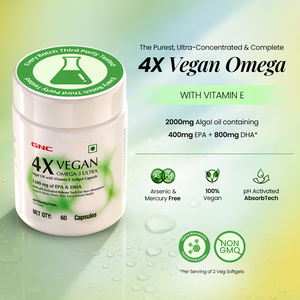
Vegan Omega is an algae-based capsule in the omega-3 and fish oil range, and it can be read against the checks above.
Start with the source. GNC Vegan Omega is algal oil sourced from microalgae, which puts it in the vegetarian row of the table above, alongside anyone who prefers to keep fish out of their routine.
Next, the two lines to look for. The Vegan Omega product page lists 100mg EPA and 200mg DHA, so it carries both omega-3s rather than DHA alone.
The page does not say whether those EPA and DHA figures are per capsule or per serving. Check the pack before you compare them with any other label.
Vegan Omega's shell is a plant-based HPMC capsule, free from gelatin, so the capsule matches the oil inside it.
The page's directions are to take one or two capsules daily with water after a meal.
The Bottom Line
Algae versus fish sounds like a choice between two different nutrients. It isn't.
Both deliver DHA. Fish oil and some algae oils deliver EPA as well. Three trials, from 2008 to 2025, found algae raised blood omega-3 levels about as well as fish did, though each was small or short and the largest had authors from the algal oil's own supplier.
So the source is a lifestyle decision. The label is the nutritional one.
That split matters in India, where plenty of households cook vegetarian and fish never reaches the plate. For them, algae oil is not a second-best stand-in; it can carry the same pair of omega-3s, from a source that fits the way they already eat.
If you do eat fish, pick whichever capsule's EPA and DHA figures match what you are after. For the wider background on omega-3s, our omega-3 basics guide is a good next read.
Frequently Asked Questions
Does algae oil have EPA as well as DHA?
Some algae oils do and some do not. Every algal oil omega-3 supplement supplies DHA, but EPA depends on the product, so check the label for a separate EPA line in milligrams. If the label lists only DHA, assume the capsule carries little or no EPA and compare accordingly.
Is algal oil the same thing as algae oil?
Yes. Algal oil and algae oil are two names for the same thing: an oil taken from microalgae that supplies omega-3 fats. Research papers tend to say algal or microalgal oil, while packs often say algae. Neither name tells you the EPA and DHA content, so the label still decides.
How does algae oil compare with krill oil?
Algae oil suits people who avoid all animal sources, and krill oil does not, because krill are small crustaceans. Krill oil also carries its omega-3s mainly as phospholipids, a different chemical form, according to NCCIH. For either, compare the EPA and DHA milligrams on both labels.
Can flaxseed give you the same omega-3?
Not directly. Flaxseed oil contains ALA (alpha-linolenic acid), a plant omega-3 that differs from the EPA and DHA in algae and fish oils. Walnuts and chia seeds carry ALA too, but if EPA and DHA are what you are after, flaxseed isn't a like-for-like swap for an algae or fish capsule.