











Quick Answer: Yes, pea protein is good for building muscle when you take a full serving and train. In a 12-week trial of 161 men, 25 g of pea protein twice a day built biceps thickness with no clear difference from whey. Pea protein has fewer essential amino acids and less methionine than animal proteins, so serving size matters.
You've switched to a plant-based shake. Maybe you've stopped eating dairy, or maybe milk-based powders just don't sit well with you.
Then someone at the gym tells you pea protein will not build real muscle.
Can plants build muscle?
And is the person at the gym right?
It's a fair worry, because pea does carry a different mix of amino acids from dairy, and that difference is real. The question is whether it changes what happens to your muscles after a hard session.
So let's put pea head-to-head with whey, round by round: a 12-week trial that tested both, the amino acids each one brings, where the powder comes from, and how your stomach takes it.
Is pea protein better than whey?
Pea protein matched whey on muscle growth in a 12-week trial that tested them side by side. A 2015 study in the Journal of the International Society of Sports Nutrition (Babault et al.) followed 161 men aged 18 to 35 through 12 weeks of weight training.
Each man took pea, whey or a placebo twice a day, and none of them had done any strength training in the months before the study began. The researchers measured biceps thickness with ultrasound, a scan that shows how thick a muscle is.
| Head-to-head | Pea group | Whey group | Placebo group |
|---|---|---|---|
| Men in the group | 53 | 54 | 54 |
| Dose | 25 g, twice a day | 25 g, twice a day | No added protein |
| Biceps gain in the weakest starters | +20.2% | +15.6% | +8.6% |
Pea vs whey across all 161 men: a tie
Across all 161 men, pea and whey came out level, and neither pulled ahead of the other on biceps thickness. Thickness went up in every group, placebo included, because training builds muscle on its own.
The gap between the groups was only a trend (P = 0.09). In plain terms, a trend means the numbers leaned one way but were not strong enough to count as a real difference.
Strength told the same story: the three groups did not differ at all.
In the weakest starters, pea pulled ahead of placebo
Among the men who started out weakest, pea added 20.2% to biceps thickness against 8.6% for placebo, and that gap held up statistically.
Pea and whey still did not differ from each other.
That result belongs to the weakest men alone.
What one trial cannot tell you
- It studied young men only. Women and older adults were not part of it, so the result cannot simply be copied across to them.
- Three of the authors work for the company that made the pea powder. That does not make the result wrong, but you should know it.
- It's one study. A single trial is a useful starting point, but it is not the final word on any question.
Essential amino acids: where pea runs short, and how more protein covers it
Pea protein has fewer essential amino acids than whey, so you need more pea protein than whey to get the same building blocks. Essential amino acids are the nine amino acids your body cannot make on its own, so they have to come from food, and muscle needs all nine to rebuild after training.
A 2018 lab analysis in Amino Acids (Gorissen et al.) measured them across more than a dozen protein sources. Essential amino acids made up 30% of pea protein, against 43% of whey.
So pea starts behind. Why does that matter?
Which amino acid does pea protein run short on?
Methionine is one of the nine essential amino acids, and it's where pea falls furthest behind. Gorissen's analysis found methionine at 0.4% of pea protein, against an average of 2.5% across animal proteins.
A gap of 0.4% against 2.5% is wide on paper.
Does it mean pea cannot build muscle? No, and the researchers said so themselves: Gorissen's team noted that a low methionine share can be made up for by eating 2 to 4 times more protein.
Does a full serving close the gap?
Yes. A half scoop of pea delivers fewer essential amino acids than a half scoop of whey, so serving size stops being a detail here.
The men in the trial took 25 g twice a day, not a token spoonful.
Your total for the day counts too, and a 2018 review in the British Journal of Sports Medicine (Morton et al.) found that protein supplements added to the strength and muscle people gained from training. Beyond about 1.6 g of protein per kg of body weight a day, extra protein added no further lean mass.
So reaching your daily total matters more than going far past it.
The practical rule: count pea in full servings, and let meals of dal, rajma, chana or tofu carry the rest of your day.
Is pea protein a complete protein?
Not by the strict definition, though it comes close. A complete protein is one that supplies all nine essential amino acids in the amounts your body needs, not just a trace of each.
Pea contains all nine, and its total share of essential amino acids also met the international requirement Gorissen's team used as the benchmark.
Methionine is the exception: at 0.4% of the protein, it fell below that benchmark.
So pea ticks the "has all nine" box and misses the "enough of each" box.
Close. Not quite complete.
That second box is what protein-quality scores try to capture. PDCAAS, short for Protein Digestibility Corrected Amino Acid Score, rates a protein on two things: its amino acid mix and how well your body digests it. The top score is 1, and our explainer on how PDCAAS is worked out walks through the maths.
Is pea protein made from green peas?
Pea protein powder comes from dried yellow peas, not the green peas you add to pulao. The powder in the 12-week trial was an isolate made from yellow peas (Pisum sativum), the same kind of dried pea sold in India as yellow split-pea dal.
And the green peas in your fridge? Different food, different job.
Green peas on your plate are a whole vegetable, so every spoonful brings water, starch and fibre along with its protein.
What is pea protein isolate made from?
An isolate is dried pea with the starch and fibre taken out, in four steps the trial paper describes:
- Dried peas are cleaned and ground into flour.
- The flour is mixed with water.
- The starch and the fibre are pulled out separately.
- The protein part is collected and dried into powder.
What is left is an isolate, a powder that is mostly protein, and Gorissen's analysis found pea protein isolates were 77% to 81% protein.
If you want the isolate step explained in more depth, our post on why a plant isolate carries more protein and less filler covers it.
How easy is pea protein to digest?
Most people handle pea protein without trouble, and it contains no lactose, the milk sugar some people struggle to digest. In the 12-week trial, tolerance was good and similar across the pea, whey and placebo groups.
Why an isolate is not a bowl of peas
Whole peas carry fibre and starch along with their protein. The isolate leaves both behind.
So a scoop of pea isolate is a different food from a plate of matar.
Same plant. Different load.
What are the side effects of pea protein?
For healthy adults, the trial found nothing that set pea apart from whey or placebo. Three situations still call for care:
- Pea allergy. If you're allergic to peas, skip pea protein. If you have any food allergy, read the label and ask your doctor first.
- New to protein powder. Starting with one serving a day lets you see how it sits with you before you add more.
- Health conditions. If you have a medical condition such as kidney disease, are pregnant or take regular medication, consult your doctor before adding any protein powder.
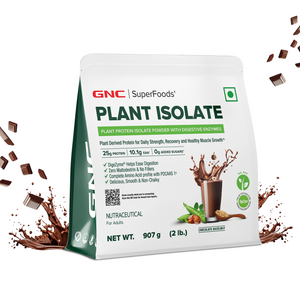
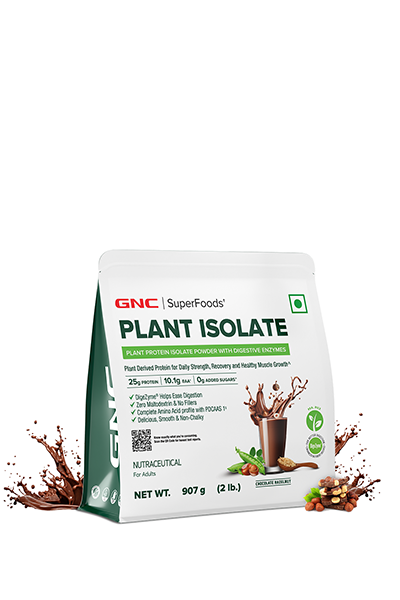
Pea protein in GNC Superfood Plant Isolate
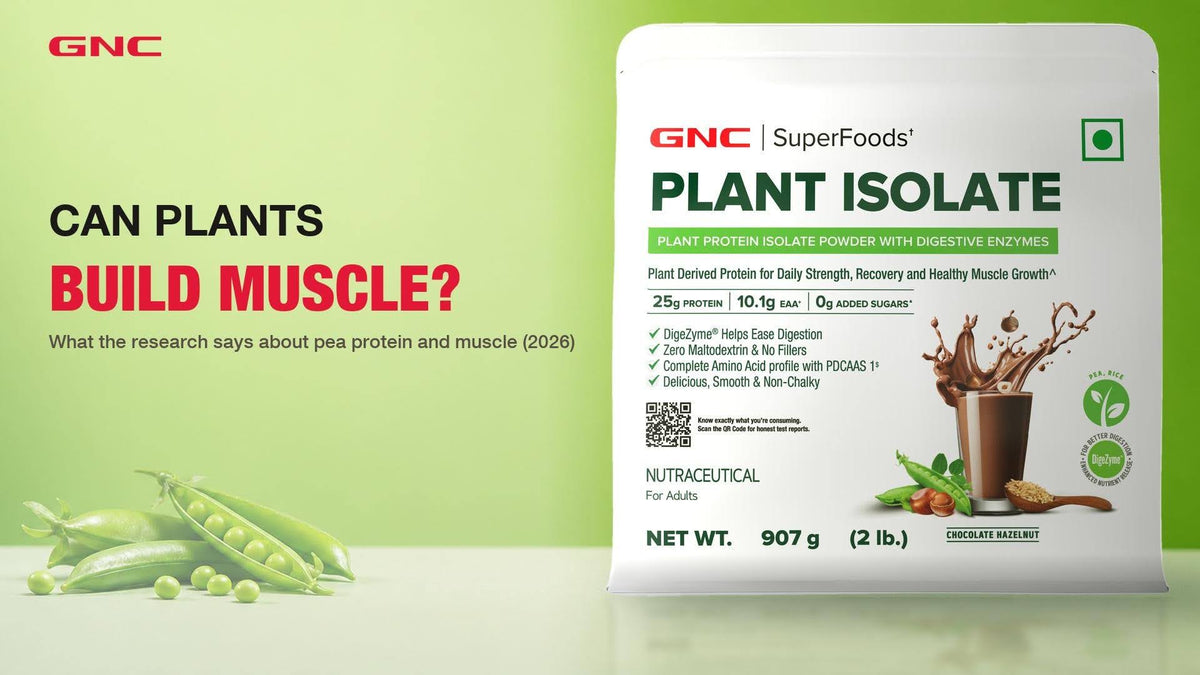
GNC Superfood Plant Isolate puts this article's lessons into one tub. Its ingredient list names a Plant Protein Blend of Pea Protein Isolate and Brown Rice Protein, so the pea you've been reading about is the first protein named in the blend.
What one scoop carries
We describe it as "Complete plant-based protein with 25g protein and 10.1g EAAs per scoop." EAAs are the nine essential amino acids, the group in which pea runs short on methionine. The product page calls it a complete plant protein with all the 9 EAA. Mix 1 scoop with 350–400 ml of water or plant milk.
The formula also includes DigeZyme, a multi-enzyme complex which includes Alpha-Amylase, Protease, Lipase, Cellulase, and Lactase. Each enzyme is named for what it breaks down: starch, protein, fat, fibre and lactose.
One serving a day, at a time you can keep
The product page's direction is 1 serving per day, and it says consistency matters more than timing: take it once daily, at a time you can stick to. Post-workout is the page's recommended slot, with morning, between meals or evening as other options.
One scoop will not carry your whole day's protein, so count it as one full serving on top of your meals.
The GNC Superfood Plant Isolate product page has the full details, and the plant protein range shows the rest of the plant line.
The Bottom Line
Pea protein showed no clear difference from whey for muscle growth in a 12-week head-to-head trial, within the limits of one study of young men. Its weak spot is methionine, and the fix for that is not a special formula.
The fix is enough protein.
So don't judge pea by the half scoop you tried once. The real pea protein benefits for muscle show up with full servings, steady training and meals that pull their weight. If you are still deciding between the two broader families, our guide to plant protein vs whey protein compares them on taste, digestion and daily use.
Frequently Asked Questions
Can pea protein match whey for gains?
In a 12-week trial that compared them directly, yes: over 12 weeks, 161 men taking 25 g of pea protein or whey twice a day gained biceps thickness with no clear difference between the two. Pea carries fewer essential amino acids, so use full servings.
Is pea protein safe to take daily?
For healthy adults, daily pea protein is generally well tolerated. The men in the 12-week trial took it twice a day, and tolerance was similar to whey and placebo. If you're allergic to peas, skip it.
Is pea protein the same as sattu?
No. Sattu is a flour made from roasted gram, a whole food that brings carbohydrates and fibre along with its protein. Pea protein is an isolate extracted from yellow peas, so it is mostly protein. Our sattu vs whey protein comparison looks at sattu as a protein source.
Does pea protein cause bloating?
In the 12-week trial, tolerance on pea protein was good and similar to whey and placebo. The isolate process takes out the pea's starch and fibre, and pea contains no lactose. If a new powder leaves you bloated, start with half a serving.