











Quick Answer: No, the type of whey protein matters far less for muscle than how much protein you eat across the whole day. An 8-week trial found similar strength gains on concentrate and hydrolysed whey. The type mostly changes lactose, fat, taste and digestion speed, which matters if milk sugar upsets your stomach.
You've settled on whey. Good.
Then the labels start talking. One tub says isolate. Another says hydrolysed. A third says concentrate and nothing else, and suddenly it feels like the plain one is the wrong choice.
Is it, though?
Here's the thing. All three start as the same liquid, left over when milk becomes cheese or paneer. What changes is how far that liquid is filtered, and whether enzymes cut the protein into shorter pieces before it reaches the tub.
That processing is real, and it changes what else lands in the scoop. But the research on what it changes in muscle tells a much quieter story than the tubs do.
Three types of whey, one starting liquid
Whey concentrate, whey isolate and whey hydrolysate are the same milk protein processed to different depths. Concentrate is filtered once, isolate is filtered further to strip out most lactose and fat, and hydrolysate is whey whose protein chains have been cut shorter by enzymes.
What processing leaves in the powder
A 2004 review in the Journal of Sports Science and Medicine (Hoffman and Falvo) set out the typical composition of concentrate and isolate. The hydrolysate row follows from how it's made.
Why "concentrate" on its own tells you so little
Notice how wide the concentrate row is.
"Concentrate" on a label can mean a powder that's mostly protein or one that's closer to a quarter protein, and the word alone won't tell you which.
Hydrolysate isn't a purity grade at all. A 2009 review in Nutrition & Metabolism (Manninen) describes each hydrolysate as a mix of peptides of different lengths, measured by its degree of hydrolysis, and notes that not all hydrolysates are created equal.
Does the type change how much muscle you build?
Not in a way the research can find, as long as the total protein is the same. In the long-term trial that compared forms at matched doses, gains came out broadly similar, and your daily protein total and your training carry far more weight than the processing.
The clearest head-to-head test is a 2017 trial in the Journal of the American College of Nutrition. Lockwood and colleagues put 56 resistance-trained men through 8 weeks of training on different whey forms, including a standard 80% concentrate and an extensively hydrolysed version.
Muscle mass rose in every group, including the placebo group.
Strength rose by similar amounts too, 4–7% on the bench press and 24–35% on the leg exercise, with no meaningful difference between the concentrate and the hydrolysed version.
The hydrolysed whey gave no muscle or strength advantage.
Your whole day outweighs your scoop
A 2018 meta-analysis in the British Journal of Sports Medicine (Morton et al.) pooled 49 trials with 1,863 people. Protein supplements added to gains in muscle and strength during training.
But the benefit levelled off. Beyond a total intake of about 1.6 g of protein per kilogram of body weight per day, extra protein added no further muscle.
For a 70 kg person, that works out to roughly 112 g a day. It comes from everything you eat: dal, curd, paneer, eggs, milk, and the scoop.
That's the number that moves results.
The type is a detail inside it. To work out how many scoops fill the gap, our guide to how much whey protein you need in a month does the arithmetic.
Faster isn't the same as more
Hydrolysed protein does reach your bloodstream faster, but faster absorption hasn't translated into more muscle. The speed is measurable. The extra growth isn't.
The study that named fast and slow protein
The idea of "fast" and "slow" protein comes from a 1997 study in PNAS. Boirie and colleagues found that whey produced a sharp, short rise in blood amino acids, while casein gave a slower, longer plateau.
Here's the twist. Over the seven hours after the meal, it was the slow protein, not the fast one, that ended with the more positive net protein balance across the whole body.
Fast won the sprint. Slow won the day.
What happened when hydrolysis was tested head-on
A 2009 study in the American Journal of Clinical Nutrition tested hydrolysis directly. Koopman and colleagues gave older men casein protein, intact or hydrolysed, and tracked it through the body.
The hydrolysed version entered the blood about 27% faster, and muscle protein synthesis came out a little higher, but that difference in synthesis didn't reach statistical significance.
So what does speed buy you? A quicker rise in amino acids after a shake, which is a real physiological effect but, for someone already eating enough protein across the day, not one the trials above could turn into a measurably bigger result.
Where the type really earns its place
The type of whey matters most for comfort, calories and taste, not for muscle. That's still worth something. A protein you can't digest comfortably, or can't stand drinking, won't help anyone.
If milk sugar bothers your stomach
Isolate carries far less lactose than most concentrates, which is why people who feel bloated after milk often find it easier. Hydrolysate made from isolate sits in the same place.
Lactose intolerance is less clear-cut than many assume. A 2010 NIH consensus statement found that most people who absorb lactose poorly don't have clinical lactose intolerance, and that most don't need to cut dairy out entirely.
If you have a medical condition, are pregnant, or take regular medication, check with your doctor before adding any supplement.
If you're counting every gram
A low-lactose, low-fat isolate puts a little more of each scoop into protein and a little less into carbohydrate and fat, which can help on a tight calorie plan.
On most days, though, it's a gram or two.
A katori of dal shifts the total more.
If taste decides whether you drink it
Hydrolysis can make whey taste bitter. A 2014 study in the Journal of Agricultural and Food Chemistry (Liu et al.) identified four peptides behind most of the bitterness in a commercial whey hydrolysate.
That bitterness may be one reason hydrolysate usually turns up as one part of a blend, not the whole tub. And honestly? A whey you enjoy enough to drink every day will do more for your routine than one that sits unopened after week two.
How to tell which type a tub actually contains
Read the ingredient list, not the front of the tub. Ingredients in India are listed in descending order by weight, so the first whey named is the one that makes up the largest share.
Four checks that settle it
- Look for the exact words. "Whey protein concentrate", "whey protein isolate" and "whey protein hydrolysate" (or "hydrolysed whey") are the terms that matter.
- Check the order. If a blend lists concentrate first, most of the whey is concentrate, even when the front of the pack leads with "isolate".
- Work out the protein share. Divide protein per serving by serving size. The higher the result, the more of the blend is likely isolate. Flavours pull it down a little.
- Spot the extras. Added lactase or protease tells you the blend was built with digestion in mind, and it's worth noting if lactose is your concern.
The guide to how to read a whey protein label walks through the full back panel.
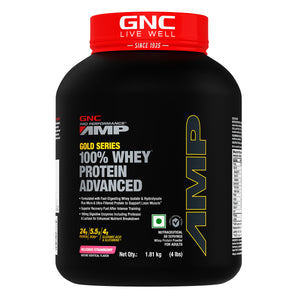
One label, three types: GNC AMP Gold Series 100% Whey Protein Advanced
The four label checks are easiest to see on a tub that uses all three types. GNC AMP Gold Series 100% Whey Protein Advanced is that example.
Its ingredient list opens with whey protein isolate, then whey protein concentrate, then whey protein hydrolysate. If the tub's label lists them in that same order, isolate is the largest share of the blend and hydrolysate the smallest.
What the rest of the label adds
The same list names two enzymes, lactase and protease. Lactase is the enzyme that breaks down milk sugar, the comfort question from earlier.
Then do the arithmetic from check 3. A blend led by isolate but mixed with concentrate will land a little lower than an unflavoured pure isolate would.
Here's what the label doesn't say. A three-way blend is a mix of the forms, not a shortcut to extra muscle. Your total protein and your training do the heavy lifting.
To compare it against a single-type whey, the full GNC whey protein range lists each tub's ingredients on its own page.
The Bottom Line
The type of whey protein is a comfort decision, not a muscle decision.
Concentrate, isolate and hydrolysate all come from the same milk, and processing only changes how much lactose and fat ride along, how fast the protein reaches your blood and how the shake tastes.
What it doesn't change, in the trials that tested it, is how much muscle you build. Lockwood's 8-week trial found no muscle or strength edge for hydrolysed whey. Morton's meta-analysis points to your daily total instead.
So start with the number: how much protein your day already gives you, and how much is missing.
Then pick the type your stomach likes.
For a feature-by-feature view of the first two types, the guide to whey concentrate vs whey isolate lays it out.
Frequently Asked Questions
What does hydrolysed whey protein mean?
Hydrolysed whey is whey protein that enzymes have already cut into shorter chains called peptides. It's sometimes called "pre-digested". It's made to be absorbed faster, and a study on hydrolysed casein found exactly that. It can also taste more bitter, which may be why it usually appears as one part of a blend.
Does whey isolate have lactose?
Yes, but very little. Isolate is filtered until lactose drops to around half a percent of the powder, far below most concentrates. That's why people who feel bloated after milk often manage isolate better. A milk allergy is a different matter from lactose, and all three types come from milk.
Is hydrolysed whey easier to digest?
Hydrolysed whey is absorbed faster, which is not quite the same thing. A 2009 study found hydrolysed casein entered the blood about 27% faster than the intact version. Whether it feels easier on your stomach also depends on its lactose, which comes from the starting whey.
Which type of whey should a beginner start with?
Whichever type your stomach tolerates and you'll drink consistently. For most beginners that's a concentrate or a concentrate-isolate blend. If milk tends to bloat you, try isolate. Spend your attention on hitting a steady daily protein total, because that's what the research links to results.
Is a blend of whey types better than a single type?
Not for muscle, on current evidence. A blend mixes isolate's low lactose with hydrolysate's speed in one scoop, but the trial that compared forms found similar gains when total protein matched. It's a comfort and taste choice.