











Quick Answer: DIAAS, the Digestible Indispensable Amino Acid Score, measures how much of each essential amino acid your body actually absorbs from a protein. PDCAAS truncates every result at 1.0, and DIAAS does not, which is why it separates soy protein isolate near 87 from pea and rice well below it.
Two vegan protein tubs sit in front of you, both printing much the same protein figure on the front. One is rice, the other a blend. Neither label tells you how much of that protein your body will actually absorb.
The number found at the front of a pack refers to the weight and specifies the quantity of protein found in the given amount. In itself, the number does not provide any information regarding the digestion quality and the ratio of amino acids present in the body.
Those are separate questions, and nutrition science answers them with a score you'll almost never see printed on an Indian label.
What DIAAS measures that PDCAAS does not
DIAAS scores every indispensable amino acid on its own, using digestibility measured at the end of the small intestine, and it never caps the result. PDCAAS applies one whole-protein digestibility figure across the board and stops the score at 1.0.
That difference sounds technical, and it is the reason two labels can look identical when the proteins behind them are not. If you want the older score explained end to end, our PDCAAS 1.0 explainer covers it properly.
Why the 1.0 ceiling hides real differences
A truncated score flattens every high-quality protein into one number. Whey, casein, egg and soy all hit that 1.0 ceiling together, so truncation cannot separate them at all.
Herreman and colleagues ran the full DIAAS calculation across five animal protein sources and twelve plant ones, publishing in Food Science & Nutrition in 2020. Once the ceiling came off, the sources separated sharply.
How the score is actually determined
DIAAS is determined by measuring how much of each indispensable amino acid reaches the end of the small intestine. Each one is then expressed as a ratio against a reference requirement pattern, and the lowest ratio becomes the score for the whole protein.
Where you measure matters. Anything sampled further down the gut has already been worked over by bacteria, so a faecal figure flatters a protein your own enzymes never really broke apart.
Why the lowest amino acid sets the whole score
The scarcest indispensable amino acid caps the score, because your body cannot keep building tissue once one of them runs out. Herreman's team put it plainly: the most limiting digestible indispensable amino acid defines the DIAAS value of that protein.
Think of it like cooking. A recipe needs nine ingredients and you have eight of them. Stocking up on those eight does not get the dish made, and the one you are missing is what decides the outcome.
How researchers get the number
The FAO method uses the growing pig rather than the rat, because pig digestion tracks yours more closely. Moughan and Lim reviewed a decade of that work in Frontiers in Nutrition in 2024 and concluded DIAAS is currently the most accurate score for rating single-source proteins.
Newer routes are arriving. A non-invasive dual-isotope assay now measures the same thing in living people, and lab-dish methods are catching up. Komatsu and colleagues tested milk, plant and insect proteins with the INFOGEST digestion protocol in the Journal of Agricultural and Food Chemistry in 2023.
Soy, pea and rice: where each scores and why
Soy protein isolate scores highest of the common vegan sources, pea concentrate sits in the middle, and rice lands at the bottom. Oh, Park and Kim measured all of them in cannulated pigs and published the 2025 values in Animals.
Adult values from Oh, Park and Kim (2025). Limiting amino acids from Herreman and colleagues (2020).
Why legumes and cereals fail on different amino acids
Legumes run short on the sulphur amino acids, cereals do not contain enough lysine. Herreman's dataset put pea, soybean, lupin and fava bean in the first group, all of them limited by methionine and cysteine. Rice, wheat, maize and oats fall into the second.
That split is the single most useful thing on this page, and you'll see why in the next section. It's also why a rice-only vegan protein and a pea-only vegan protein fail in opposite directions.
Why the FAO bands do not line up with the adult column
The FAO's quality bands are built on the reference pattern for children aged 6 months to 3 years, not the adult one. So they do not map directly onto the adult column in the table above.
Transformation is known to influence results. According to Bailey, Fanelli and Stein, in Journal of the Science of Food and Agriculture, rice and pea protein concentrates received scores of less than 75, and heat treatment allowed the rapeseed isolate to score past 100.
Why blending two plant proteins raises the score
The reason why the combination of proteins is successful is that they have different deficiencies in amino acids. For example, combining pulses low in methionine with cereals deficient in lysine allows the two ingredients to offset each other's shortcomings, so the lowest ratio in the mix lands higher than the lowest ratio in either source alone.
Stroebinger, Hodgkinson and Moughan showed the arithmetic in The Journal of Nutrition in 2024. Pea protein isolate on its own scored 61 and whey concentrate scored 96. A 25:75 blend of the two scored 104, above both parents.
That particular mix is not vegan, and it is worth being straight with you about that. What it proves is the principle: digestible amino acid contents are additive, so you can predict a blend's score from its parts.
Herreman's team found the same effect using plants alone. Potato, soy and pea complement a broad range of plant proteins at specific ratios, which they described as a route to strong protein quality from plant sources only.
Why protein per 30 g is only half the comparison
Protein per serving tells you the quantity. DIAAS tells you the quality of that quantity. You need both, and even together they do not finish the picture.
Matthews and colleagues made that case in The Journal of Nutrition in 2025. Chemical scores describe composition and digestibility, but they do not capture what those amino acids go on to do in your body, and leaning on any single metric produces generic advice.
Their practical takeaway travels well to the shelf. Look at essential amino acid density, at digestibility, and at whether this is a protein you will genuinely drink every day. Diets built heavily on whole-food plant protein may need a higher total intake to land in the same place.
So when you're comparing two vegan tubs, read three things: the protein per scoop, what the protein is made from, and whether the amino acid profile is complete. That third one is the hardest to read off a front-of-pack panel.
GNC Superfood Plant Isolate: a pea and rice blend, worked through
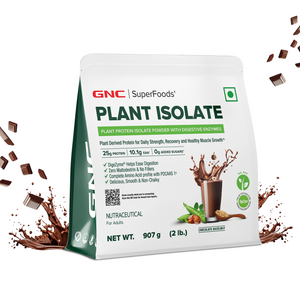
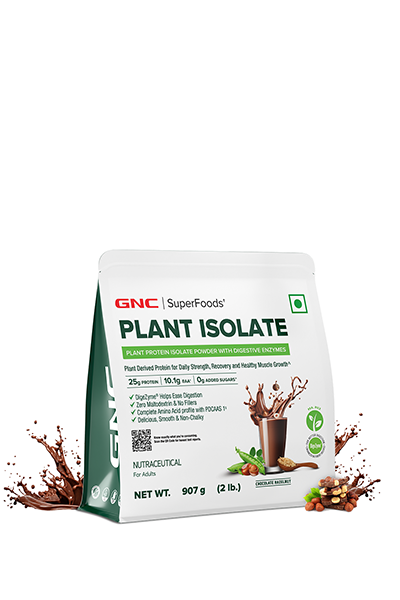
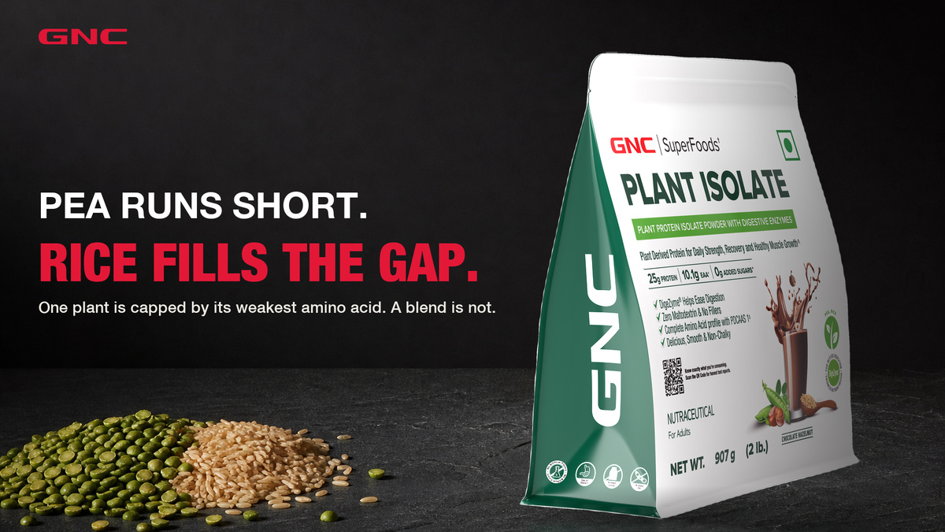
GNC Superfood Plant Isolate is built on exactly the complementary pairing this article has been describing. The ingredient list reads Pea Protein Isolate and Brown Rice Protein: a legume limited by methionine and cysteine, sitting alongside a cereal limited by lysine.
What the label publishes
Complete plant-based protein with 25g protein and 10.1g EAAs per scoop. The label also carries a PDCAAS of 1, which is the older score, capped at 1.0, that this article opened by explaining.
Thinking about moving to plant protein? The full plant protein range lists what is stocked, and the GNC Superfood Plant Isolate product page carries the full ingredient list and mixing directions.
What no plant protein tub in India can tell you yet
No plant protein sold in India carries a DIAAS figure, and that includes ours. Published DIAAS values exist for protein ingredients measured in research settings, not for finished retail blends, so a number on a tub would be an invention.
What you can check yourself is the composition. Does the tub pair a legume with a cereal, or does it lean on one source alone? If your reluctance to switch is based on taste, you should read our article on how plant isolates got drinkable.
The Bottom Line
DIAAS is the finer instrument, and the reason some vegan proteins score higher is structural rather than marketing. A single plant source is capped by whichever amino acid it runs short on. A well-chosen blend is not.
Soy holds up best among single vegan sources on the published adult numbers. Pea and rice both sit lower on their own, which is precisely why you so often find them sold together. If you're weighing soy specifically, our soy protein explainer goes deeper on that one source.
Powder is there to top up real meals, not to stand in for them. If you have a medical condition, are pregnant, or take regular medication, please consult your doctor first.
Frequently Asked Questions
Is DIAAS more accurate than PDCAAS?
DIAAS is the more precise measure. It scores each indispensable amino acid separately using digestibility read at the end of the small intestine, and it does not truncate at 1.0. Moughan and Lim concluded in 2024 that DIAAS is currently the most accurate score for rating single-source proteins.
Can a vegan protein score as high as whey?
Not usually as a single source. Soy protein isolate reached 87 on the adult pattern in the 2025 pig study, while whey isolate has been reported above 100. Blends narrow that gap, because complementary sources lift the limiting amino acid that caps the score.
Why are pea and rice blended together?
Because they run short on different amino acids. Pea is limited by methionine and cysteine, rice by lysine, so each covers the other's weakest point. Herreman and colleagues showed in 2020 that plant proteins mixed at specific ratios reach higher scores than either source alone.
Does digestibility change how much protein you should take?
Digestibility can change your total intake. Matthews et al. noted in 2025 that in certain cases, diets built heavily on whole-food plant protein may need a higher total protein and energy intake to deliver the same amino acids. Isolates and blends narrow that gap, because more of their protein is digested and absorbed than in whole-food plant sources.